Stainless Steel Worm Gear for CNC Machinery | DIN 5 SCM415
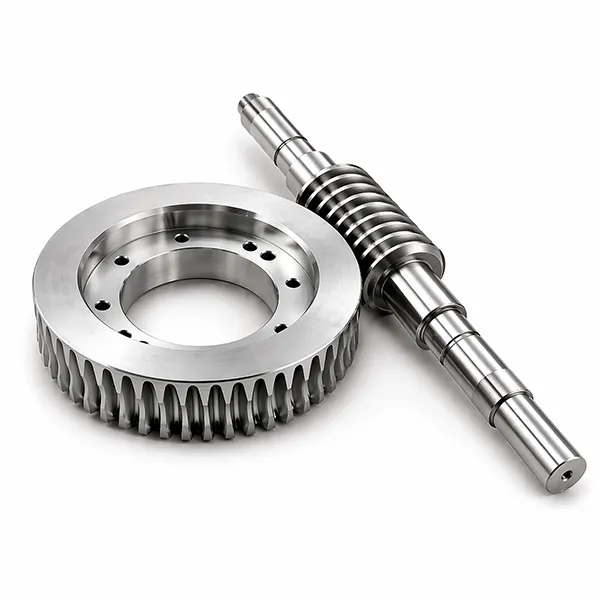
Carburised SCM415 and stainless steel worm gears for CNC machine tools, cut from Module 1 to Module 4 at DIN 5 to DIN 7 accuracy, surface-hardened to 55–60 HRC and ready for 5-axis mills, Swiss turning centres and grinding spindles across Korean machine-tool OEMs.
Introducing the Stainless Steel Worm Gear for CNC Machinery
Ever-Power's stainless and carbon-steel worm gear for CNC machinery is a precision component engineered for the high-accuracy, low-backlash duty that machine-tool spindles and rotary tables require every production shift. Built to ANSI or DIN standard dimensions and available in 1045 carbon steel or grade-304 stainless, each piece is hobbed, shaved and surface-hardened to 55–60 HRC so the tooth flank survives the aggressive coolant mist and cyclic reversing loads inside a modern machining centre. Module range spans M1 to M4 with a tooth-count envelope from Z15 to Z70, covering nearly every subordinate gearing need on a Korean-built 5-axis mill.
Korean CNC builders in Changwon, Masan and Jinju specify this gear family because it drops directly into existing spindle indexers, C-axis drives on turning centres, and ATC (automatic tool changer) magazine indexers without housing modification. Finished bores, pilot bores and keyway-plus-tap options all ship from the same catalogue part number — the bore configuration is selected at order entry, so lead time stays at the standard 25 business days even when a customer asks for a non-standard hub detail.
Full Parameter Table
The specification table below is the complete engineering envelope our QC team signs off against on every finished batch. Korean buyers normally cross-check this against their own drawing before releasing a purchase order — any deviation triggers an engineering review.
| Parameter | Specification |
|---|---|
| Product Name | Worm Gear and Worm Wheel for CNC Machinery |
| Materials Available | Stainless steel, carbon steel (1045), brass, bronze, iron, aluminium alloy, copper, engineering plastics (PA66, POM, Derlin, PEEK) |
| Heat Treatment | Quenching & tempering, carburising & quenching, high-frequency hardening, carbonitriding |
| Surface Treatment | Tooth-surface induction hardening, tempering, carburising |
| Bore Options | Finished bore, pilot bore, keyway + tap, special request |
| Processing Methods | Moulding, shaving, hobbing, drilling, tapping, reaming, manual chamfering, grinding |
| Pressure Angle | 20 degrees (standard) |
| Hardness | 55–60 HRC on tooth flank |
| Size | Customer drawing or ISO standard |
| Packaging | Wooden case, container and pallet, or made-to-order |
| Certification | ISO 9001:2015 |
| Typical Applications | Electrical machinery, metallurgical equipment, environmental systems, road construction, chemical plants, food processing, light industry, mining, rubber and petroleum machinery |
| Catalogue Advantages | ANSI/DIN compliant, SCM415 material, finished bore, DIN 5 – DIN 7 grade, carburised, Module 1–4, Z15–Z70 |
| Module | Tooth Count (Z) | Typical Bore Range | Face Width | Helix Direction |
|---|---|---|---|---|
| M1.0 | Z20 – Z100 | Ø6 – Ø15 mm | 8 mm (typical range) | L or R |
| M1.5 | Z20 – Z100 | Ø12 – Ø20 mm | 12 mm | L or R |
| M2.0 | Z15 – Z100 | Ø12 – Ø25 mm | 16 mm | L or R |
| M2.5 | Z15 – Z80 (typical range) | Ø15 – Ø30 mm | 20 mm | L or R |
| M3.0 | Z20 – Z70 | Ø20 – Ø40 mm | 24 mm | L or R |
| M4.0 | Z20 – Z70 | Ø25 – Ø50 mm | 32 mm | L or R |
Bore finish is selected at worm gear order entry — straight bore, straight bore with tapping, or keyway plus tap. A single catalogue part can ship with any of the three finishes without a tooling change.
Why Stainless Grade Matters on Machine-Tool Spindles
Inside a modern machining centre, the worm gear lives in a hostile environment: aggressive water-soluble coolant mist, metallic swarf, and thermal cycling between cold morning starts and hot afternoon finishing cuts. Carbon-steel worm gears can survive this, but they need frequent oil changes and eventually show rust streaks along the bore and bearing journals. Stainless 304 and 316 grades handle the same environment without corrosion for the full machine lifetime — which is why Japanese and German machine-tool builders have moved a large portion of their non-primary worm gearing to stainless over the past decade.
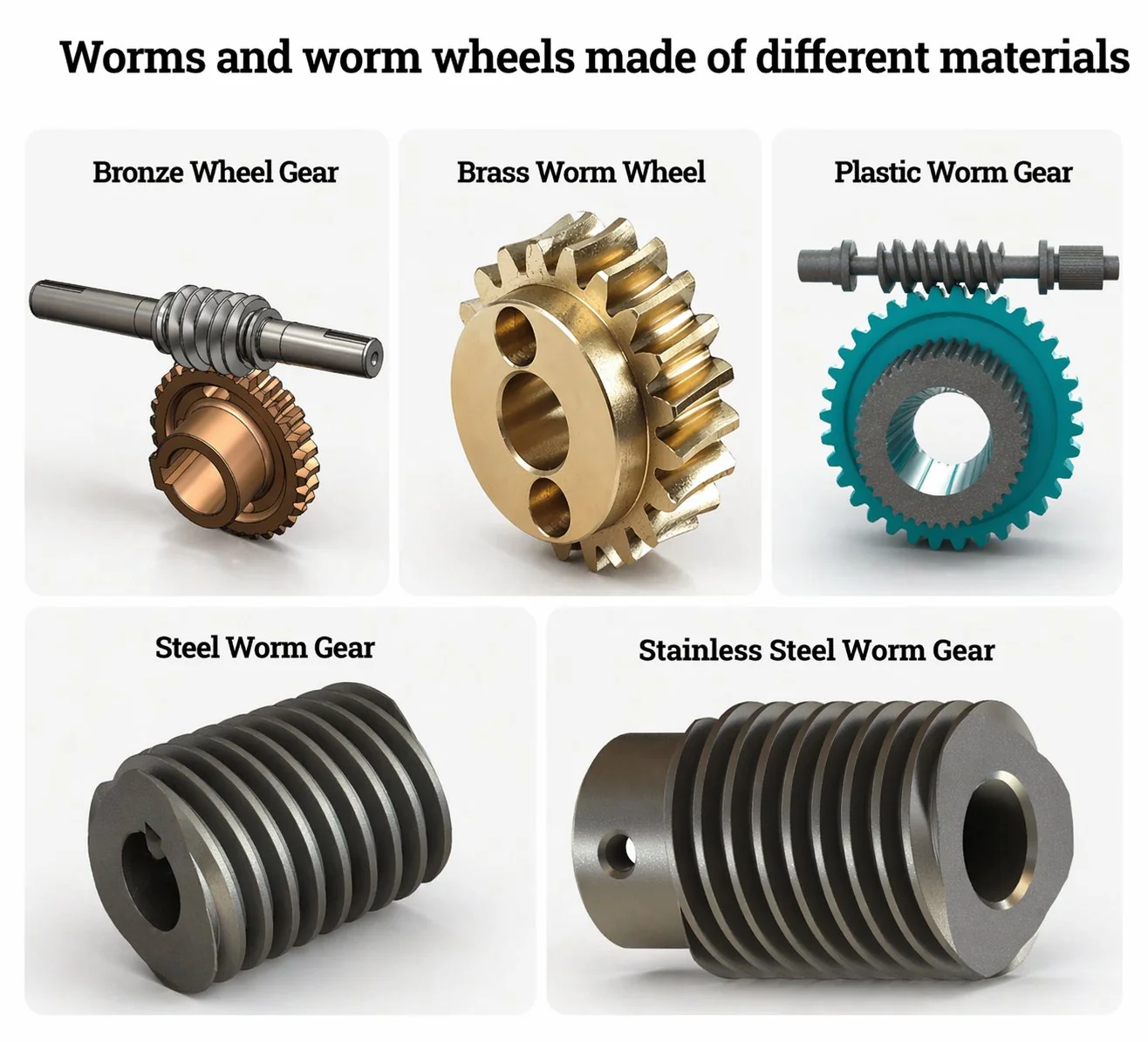
The trade-off is obvious. Stainless is roughly 30 % harder to machine than SCM415, and its ultimate tensile strength after carburising sits about 10 % below case-hardened alloy steel. For primary power-transmission paths where peak torque is the dimensioning factor, stainless worm gear material is usually not the right choice. For ATC magazines, secondary indexers and coolant-manifold actuators where corrosion is the dominant risk, stainless wins every time. Ever-Power stocks both the stainless worm wheel and the carbon-steel worm wheel in the same module sizes so customers can mix the two materials on the same machine without redrawing the gear train.
Precision Class from DIN 5 to DIN 7 Explained
Three accuracy grades cover almost every CNC worm gear application. Getting the choice right matters because each step tighter doubles the tooth-grinding time on the shop floor and adds roughly 15 – 20 % to the unit cost.
- ■DIN 5 — for ultra-precision worm drives. Used on 5-axis rotary tables, jig grinders, and optical metrology stages. Backlash measures under 8 arc-seconds on a 100 mm pitch-diameter worm wheel. Expect a 35-day lead time because every tooth is ground after heat treatment.
- ■DIN 6 — for C-axis and ATC worm drives. The workhorse grade on most Korean-built CNC lathes and mills. Backlash holds around 15 arc-seconds, positioning repeatability reaches ±0.01 mm at the tool tip.
- ■DIN 7 — for coolant and chip-conveyor worm drives. Fine enough for auxiliary drives that need quiet running but not positional accuracy. Milled-and-hardened only, no tooth grinding required — keeps unit cost at the catalogue baseline.
Heat Treatment and Surface Hardening Routes
The hardness figure on the worm gear drawing is achieved by one of four treatment routes, each carrying different lead-time and cost implications. The choice depends on the duty cycle and load spectrum of the downstream CNC worm drive application.
| Method | Achievable Hardness | Case Depth | Best Fit |
|---|---|---|---|
| Quench & Temper (through-hardening) | 45 – 52 HRC | n/a (through) | Medium-duty C-axis drives |
| Carburise & Quench (case-hardening) | 58 – 62 HRC | 0.6 – 1.2 mm | Primary spindle indexers, heavy-load paths |
| Induction (high-frequency) hardening | 50 – 58 HRC | 1.0 – 3.0 mm | Mid-duty indexers and ATC magazines |
| Carbonitriding | 55 – 60 HRC | 0.2 – 0.6 mm | Smaller modules, stainless grades |
Tooth grinding after heat treatment is the standard finishing step on DIN 5 and DIN 6 worm gear parts — it removes the micro-distortion that every quench inevitably produces and delivers the flank finish (below Ra 0.4 µm) that the tight accuracy classes require.
Benchmarking Against Nabtesco and Mitsubishi Heavy Industries
Nabtesco and Mitsubishi Heavy Industries (MHI) are registered brand names belonging to their respective owners. Ever-Power is not a reseller or counterfeiter of their gear-reducer products — this benchmarking section is provided to help Korean CNC machine-tool builders weigh the sourcing options. We manufacture our own equivalent-class worm gear components.
The comparison focuses on CNC-grade worm gearing used in rotary tables, C-axis worm drives and ATC indexers on Korean-built machining centres. Figures are drawn from public datasheets and from our sales experience supplying several Korean machine-tool OEMs who had previously specified these brands.
| Criterion | Ever-Power | Nabtesco (Japan) | Mitsubishi HI |
|---|---|---|---|
| Accuracy Grade | DIN 5 – DIN 7 | JIS class 0 – 2 | JIS class 1 – 3 |
| Module Range | M1 – M4 | Cycloidal, not worm (different tech) | M1 – M8 |
| Stainless option | Yes, stocked | On request | On request |
| Custom tooth count | MOQ 10 pcs | Special order | MOQ 50 pcs |
| Standard lead time | 25 business days | 8 – 14 weeks | 6 – 12 weeks |
| Unit price index | 100 | approx. 250 (cycloidal premium) | approx. 190 |
| Technical support in Korean | Yes, direct | Via distributor | Via distributor |
Realistic takeaway: Nabtesco's cycloidal reducers dominate the very-highest precision robotics niche where zero-backlash is non-negotiable, and MHI remains a reasonable pick when a Korean builder wants a Japanese brand on the machine nameplate. For every other position on the machine — secondary drives, auxiliary axes, ATC magazines, chip conveyors — Ever-Power's 25-day lead time at half the unit price changes the total machine-build economics meaningfully.
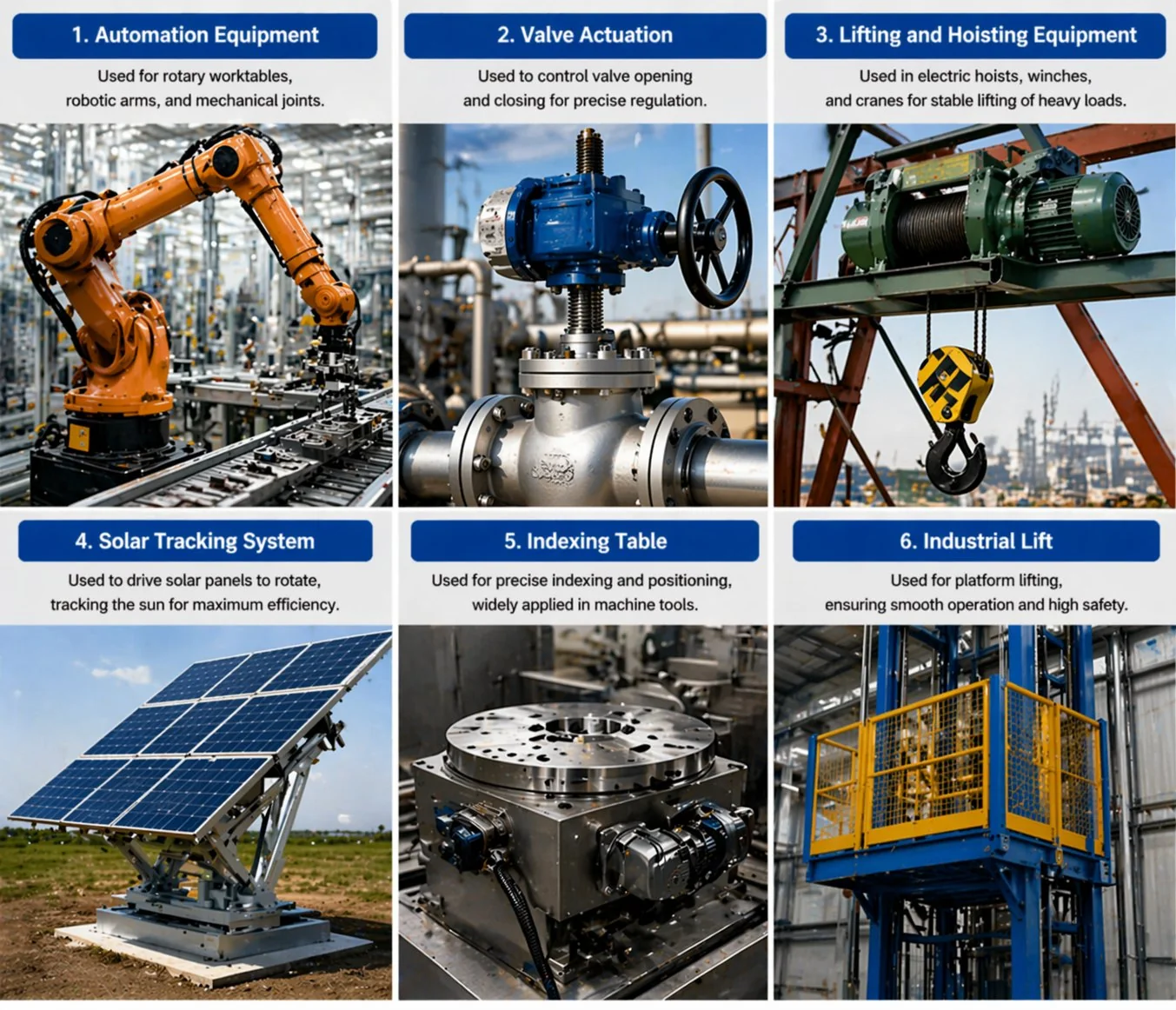
Industry Fit: CNC Applications That Use This Gear
The same 1045 or stainless worm gear serves multiple roles across a Korean-built machine tool. The list below shows where Korean customers have actually deployed this catalogue worm gear over the past three years.
5-Axis Milling Rotary Tables
◉ DIN 6 grade, M3 module, carburised SCM415 — the standard worm gear spec for A-axis and C-axis rotary stages on Korean-built simultaneous 5-axis machining centres. Positioning repeatability of ±0.005° on a 320 mm table.
Automatic Tool Changer Magazines
◉ DIN 7 grade, M2 module, stainless — specified for chain-type and carousel-type ATC magazines that live inside the main spindle enclosure. The stainless worm wheel eliminates the corrosion failures that plagued earlier carbon-steel parts after three years of coolant exposure.
Swiss Turning Centres
◉ DIN 6 grade, M1.5 module, carbonitrided — the worm gear that drives the tool-turret indexer on Swiss-style sliding-headstock lathes used for medical and aerospace micro-components. Compact envelope fits the tight stack of tooling in a Swiss head.
Cylindrical and Internal Grinding Machines
◉ DIN 5 grade, M2 module, stainless ground — used as the worm gear on the C-axis of cylindrical grinders where thermal stability and cleanliness matter. Our Seoul technical desk supports the first-article certification required by precision-grinding QC departments.
EDM and Wire-EDM Axes
◉ DIN 6 grade, M1 module, stainless — the worm gear that drives the wire-feed and U-V axes on wire-cut EDM machines. Dielectric fluid is aggressive on carbon-steel worm gears, so stainless is effectively mandatory.
Packaging, Certification and Companion Drive Products
Before looking at companion products, it helps to know how the worm gear arrives at the Korean port. Every shipment follows the same five-point checklist so customs clearance and incoming QC go smoothly.
- ✓Wooden case or container pallet packing, oriented strand board (OSB) base, fumigation-certified for Korean customs clearance.
- ✓VCI-paper wrap around each worm gear, silica-gel desiccant inside each sealed bag — keeps finished bore free of corrosion through 45 days of ocean freight.
- ✓ISO 9001:2015 quality system, RoHS compliance statement, REACH declaration, and 3.1 material certificate shipped with every batch.
- ✓Weekly sailings from Qingdao and Shanghai into Incheon, Busan and Gwangyang; door-to-door transit typically 9 – 14 days by sea, 3 days by air.
- ✓Korean-language customs invoice and packing list prepared by our Seoul office — zero surprises at the port inspection point.
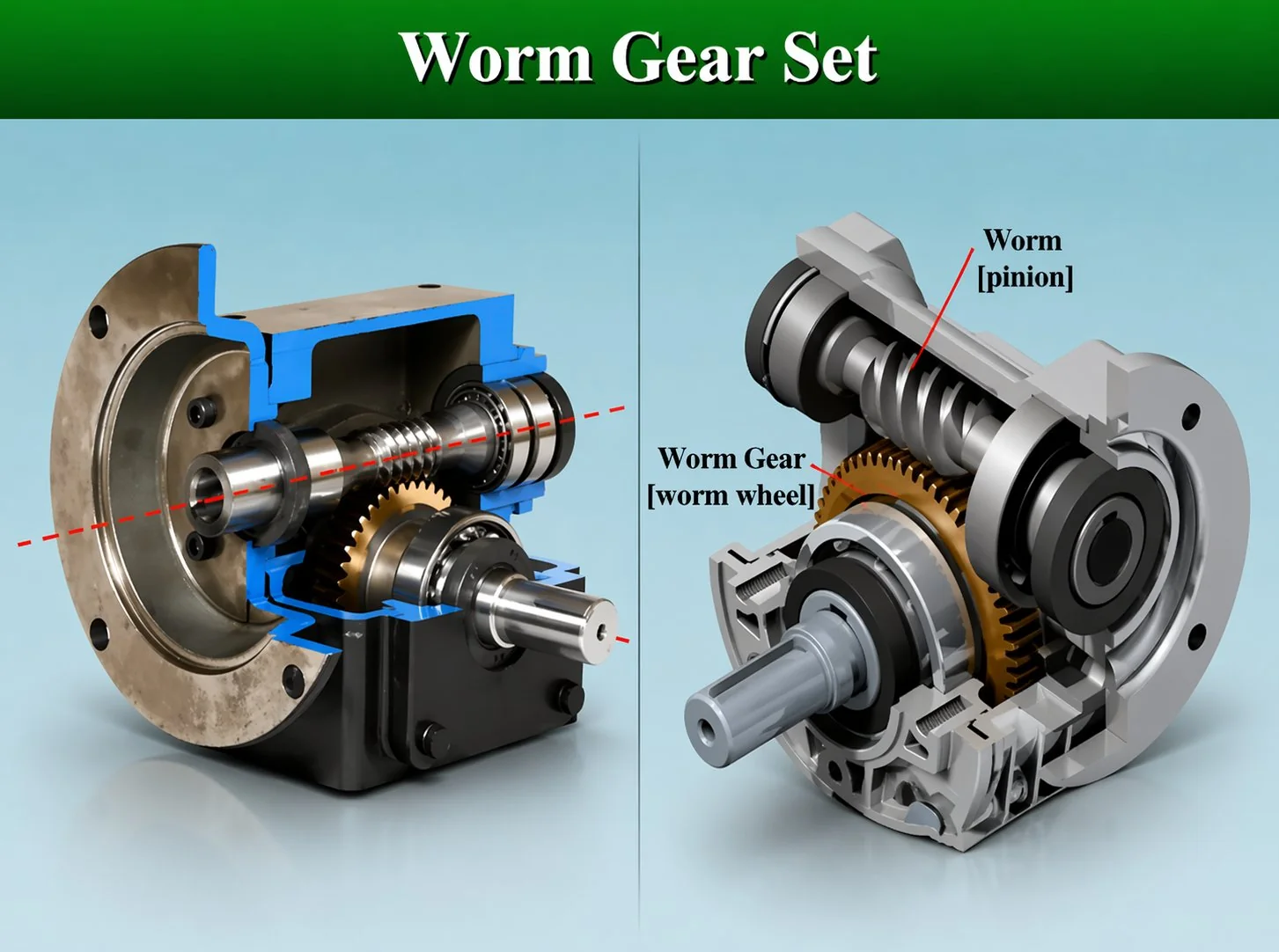
CNC builders rarely buy a worm gear in isolation. Most orders pair the worm gear with a matched hardened worm shaft, preloaded angular-contact bearings, and a housing machined from solid billet. For Korean machine-tool OEMs who prefer to outsource the complete drive as a sealed sub-assembly, a packaged worm gear reducer arrives oil-filled and pre-tested, ready to bolt to the spindle housing.
For auxiliary axes and ATC drives that include an integrated servo motor, the motor-ready worm gearbox family covers NEMA 17 through NEMA 42 flanges. The full worm gear components catalogue lists every CNC-ready worm and worm wheel module we hold in current tooling.
Frequently Asked Questions
Q: Can I order the same module in both stainless and SCM415 from one purchase order?
Yes. Split quantities are a standard option — specify the split on the PO and the finished batch ships in two labelled cartons with separate CoC sheets. Unit price reflects the material mix without any handling premium.
Q: What tolerance does DIN 6 guarantee on a 200 mm pitch-diameter wheel?
DIN 6 on a Ø200 mm wheel guarantees single-pitch deviation under 11 µm and total accumulated pitch error under 32 µm. Translated to output, that equals roughly ±12 arc-seconds of tooth-to-tooth positioning error — comfortable for most CNC C-axis drives.
Q: Do you test each gear on a Gleason rolling tester before shipment?
Yes on DIN 5 parts, sampling at 20 % on DIN 6 parts, and at final QC on DIN 7 parts. The inspection reports accompany the shipment as a PDF and can be issued in Korean on request.
Q: Will the carburised case survive a 1500 rpm input on an M3 module gear?
Yes for well-lubricated service. SCM415 carburised to 60 HRC with a 0.8 mm case handles 1 500 rpm continuous at typical CNC duty cycles. For 2 500 rpm and above, step up to 20CrMnTi with a deeper 1.2 mm case and ISO VG 220 synthetic gear oil.
Q: Can you finish bore to a customer-specified H7 fit on existing catalogue gears?
Yes. Bore finishing is done in the last machining step before heat treatment, so changing the bore diameter from catalogue default to a customer H7 size adds no lead time and no meaningful cost. Specify the bore on the PO.
Q: What certifications are needed for Korean machine-tool customs clearance?
The standard documentation pack — ISO 9001, material 3.1 certificate, RoHS and REACH statements — clears Incheon and Busan without extra review. Machine-tool parts do not normally require KATS certification as long as they ship as components rather than standalone products.
Q: Is a first-article inspection report (FAIR) available for aerospace-adjacent customers?
Yes. FAIR format matching AS9102 is supported at extra cost (typically USD 350 per gear type). Lead time for the first shipment extends by five working days to complete the documentation.
Hands-On Feedback from CNC Builders
Shin Woo-jin, Machine Tool Design Lead, Changwon (late 2025)
"We were sourcing C-axis worm gears from a Japanese brand with 10-week lead times. Ever-Power delivered equivalent DIN 6 SCM415 parts in 25 days at roughly 45 % of the cost. Backlash on the rotary table measured 14 arc-seconds after first assembly — well inside our 20 arc-second drawing tolerance. Now running on eight production machines for eleven months, no field issues."
Lim Ha-yun, ATC Subsystem Engineer, Daegu (mid 2025)
"Switched our chain-type ATC magazine gears from carbon steel to Ever-Power's 304 stainless after two generations of coolant-induced rust on the bearing journals. One year in, zero corrosion. The tooth flank finish is actually smoother than what we had been receiving from the original supplier — magazine index noise dropped by a measurable 2 dB."
Hiroshi Tanaka, Swiss Lathe OEM Engineer, Kyoto (early 2025)
"Ordered M1.5 carbonitrided gears for the tool-turret indexer on our latest Swiss-style lathe platform. The Z18 tooth count was non-standard for the supplier, but Ever-Power machined it without charging NRE because the hob already existed in their library. Inspection report was in English with Korean summary. Precision held to DIN 6 across the 50-piece first lot."
Jang Min-seok, Grinding Machine Rebuilder, Incheon (late 2024)
"Refurbished a 20-year-old cylindrical grinder with Ever-Power's DIN 5 stainless wheel on the C-axis. Sourced the replacement from a sample of the worn original — they measured it, drew it, and ground the replacement in 34 days. Customer's acceptance test confirmed ±3 arc-seconds positioning repeatability, which was actually tighter than the machine's original spec sheet."
Moon Ji-eun, EDM Machine Distributor, Ansan (mid 2025)
"Stocking replacement wire-EDM gears for machines across Korea and Vietnam. Ever-Power's stainless M1 gears have become our go-to replacement because they fit all the major Japanese OEM machines in the field. Lead time of 25 days lets us keep minimum stock without running out. Customer complaints on replacement parts have dropped from roughly eight per year to zero over the past eighteen months."
Cho Seong-hoon, Chief Mechanical Engineer, Masan (early 2026)
"Ordered a complete gear set for a new 5-axis simultaneous machining centre. A-axis and C-axis both use DIN 5 M3 carburised gears. Ever-Power's Seoul engineer came to our plant to walk through the installation on the first machine — that kind of on-site support is rare at this price point. Acceptance testing passed on the first try. Planning to standardise on them for the next three-year product roadmap."
Additional information
| Editor | Cxm |
|---|
Related products
-
Alloy Steel Worm and Worm Gear for Auto Parts | Ø5-Ø120 Module 0.2-2.2
-
Duplex Worm Gear Set | Dual-Lead Zero-Backlash Worm Drive
-
Cylindrical Worm Wheel Sets | Line-Contact Worm Gearing
-
Brass Worm Wheel & Shaft Set | 20-Tooth M0.5 Micro Gear Kit
-
Custom Worm Gear Sets | Worm Drive
-
Worm and Wheel Sets | DIN6 Worm Gearing
-
Plastic Worm Gears for Micro Drives | POM & Nylon Gear Sets