Three Types of Worm Gears — Non-Throat, Single, Double-Throat
A geometry-driven comparison of the three throat configurations, the cost-versus-capacity trade-off behind each one, and the misuse cases we keep seeing in the field.
The three throat configurations differ in one thing — how much surface area engages between worm and wheel during contact. Non-throat is point contact with one or two teeth in mesh, lowest cost, light duty only. Single-throat is line contact with three to four teeth in mesh, the industrial workhorse for 80 percent of applications. Double-throat (also called double-enveloping) is surface contact with six to eight teeth in mesh, the heavy-duty option with two to three times the load capacity but a 40 to 60 percent price premium and longer lead time. Pick by load and budget, not by what looks technically impressive on paper.
The single axis everything turns on: contact area
Stop reading any article that compares worm gear types by listing properties side by side. The three throat configurations are not unrelated alternatives — they are three points on a single continuous axis, and that axis is the geometric contact area between worm thread and wheel tooth. Every other property follows from that one variable.
Larger contact area means more teeth share the load at any moment, which means each tooth sees lower stress, which means higher load capacity, longer service life, less wear per cycle, and lower noise. It also means tighter geometric tolerances, more complex tooling, longer machining time, more expensive hobs, and significantly longer lead times. There is no escape from this trade-off — the geometry of throat envelopment forces it directly. Once you see the contact-area axis clearly, choosing the right type becomes a single-question decision instead of a feature comparison exercise.
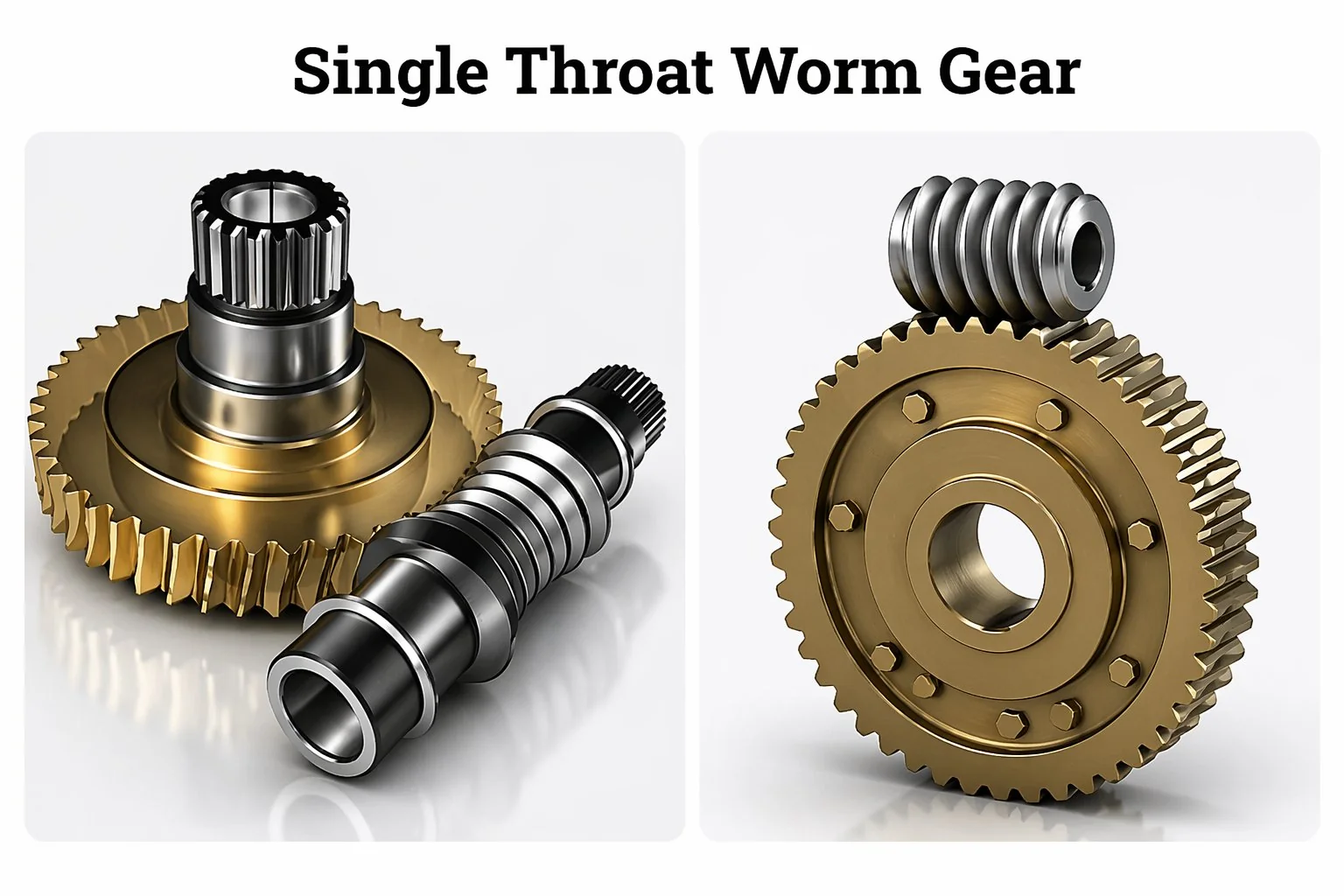
The image opposite shows the cylindrical worm meshing with a throated wheel — the most common single-throat configuration. Notice how the wheel teeth wrap around the worm body. That wrap is the throat. Take the wrap away (straight-cut wheel teeth) and you get the non-throat type. Add a matching wrap to the worm itself (hourglass shape) and you get double-throat.
From a manufacturing perspective, the cost climbs faster than the capacity benefit. Going from non-throat to single-throat roughly doubles the load capacity and adds maybe 10 to 15 percent to unit cost. Going from single-throat to double-throat doubles the capacity again but adds 40 to 60 percent to unit cost and 10 to 14 days to standard lead time. That cost-versus-capacity curve is the economic reason why single-throat dominates in industrial drives.
Non-throat — the simplest geometry
A non-throat worm gear pair is the simplest possible right-angle drive. The worm is a plain cylindrical shaft with one or more helical threads. The wheel is a flat-cut disc with helical teeth that match the worm’s lead angle. Neither component wraps around the other. Contact between them is essentially a single point at the moment of engagement, theoretically expanding into a very short line under load as the bronze wheel deforms slightly.
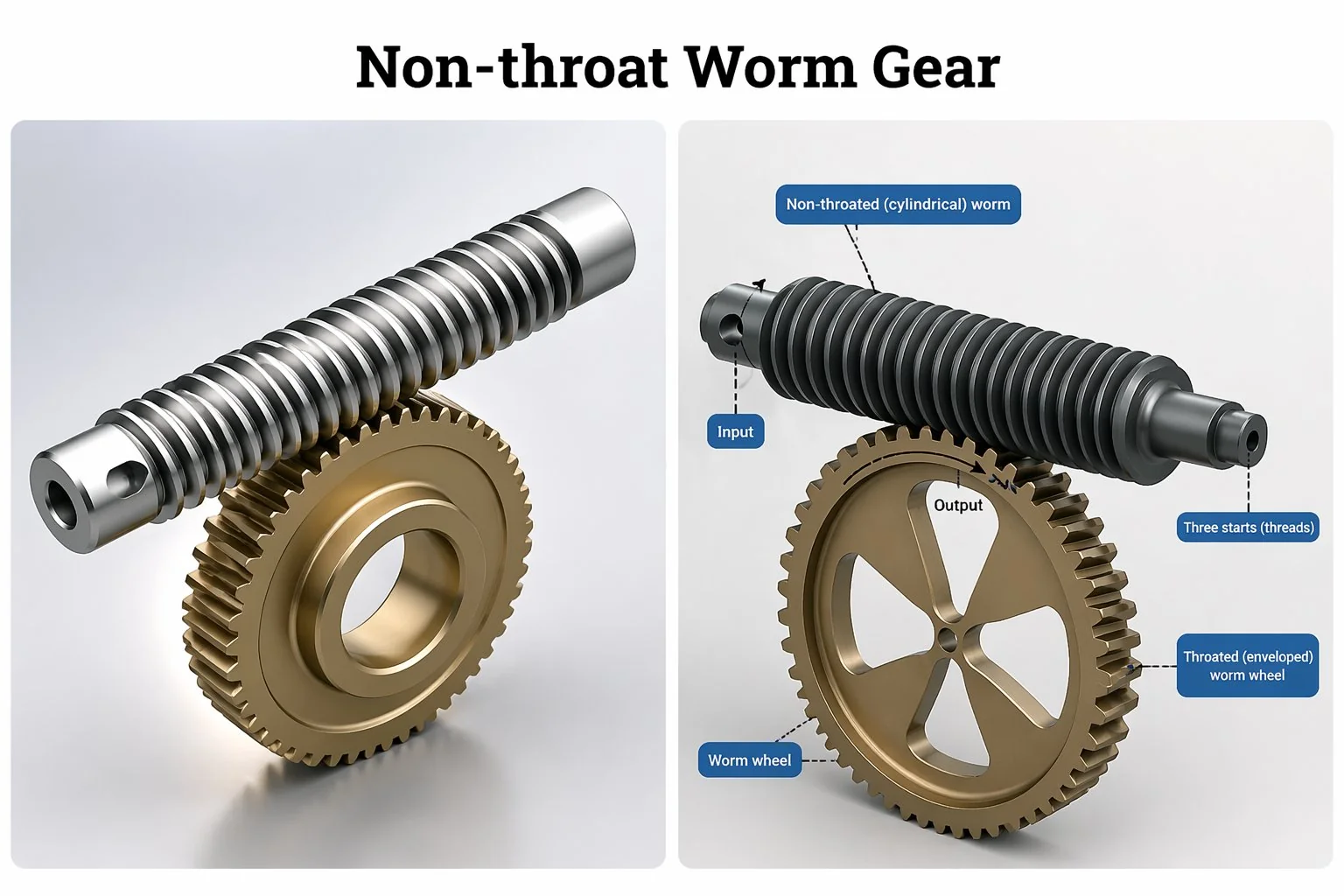
One or two teeth carry the entire load at any moment. Stress concentration on those teeth is high. Wear per operating hour is two to three times what you would see on a single-throat unit at the same torque. Replacement intervals are short — a non-throat wheel under continuous load might need replacement every 6,000 to 12,000 hours instead of the 25,000 to 40,000 hour service life expected from a properly sized single-throat set.
The compensating advantages are real, though. Tooling is the simplest of the three types — a standard spur-tooth hob will cut the wheel. Replacement parts are quick to make and cheap to stock. Lead time on a custom non-throat set is often half what a single-throat set requires. For light-duty drives where the load is well below the rated capacity and a short replacement interval is acceptable, the cost case for non-throat geometry is genuinely strong.
Where non-throat fits naturally
Office equipment indexing drives, instrument positioners, hobby and educational mechanisms, low-volume prototyping where setup time matters more than service life, and short-duty light-load auxiliaries. The common thread across these applications is that the drive operates intermittently, the load is well-defined and modest, and the operator either expects to replace the unit periodically or simply does not need 40,000 hours of service.
The misuse case we see most often
A small machine builder picks non-throat geometry because the unit cost is 20 percent below an equivalent single-throat set. The first prototype works perfectly because the design is running at maybe 30 percent of rated load. Three months into production, customer reports start coming in: the drives are wearing out at 4,000 hours instead of the 20,000 hours assumed in the warranty. The machine builder is now spending more on warranty replacements than the original cost saving. We see this scenario every quarter, and every time the right answer would have been single-throat from the start.
Single-throat — the workhorse of industrial drives
Single-throat geometry keeps the worm cylindrical but cuts the wheel teeth in a concave throat profile that wraps partially around the worm body. The wheel teeth are no longer flat-faced — they curve to follow the worm’s circumference. Three to four teeth are in mesh at any moment, and the contact between worm thread and wheel tooth is a short line rather than a point.
The throat is what makes the difference. By distributing load across multiple teeth simultaneously, peak stress on any single tooth drops by roughly 60 percent compared with non-throat geometry. Surface wear rate drops correspondingly. Service life climbs from 6,000 to 12,000 hours at light duty into the 25,000 to 40,000 hour range under properly sized continuous load. Acoustic noise drops noticeably because the multi-tooth engagement smooths out the load pulses each tooth would otherwise experience individually.
In two decades of shipping worm and worm wheel sets out of Ansan, single-throat is what we deliver to roughly four out of every five orders. It is the answer when the customer does not have a strong reason to specify something else. Industrial conveyors, machine-tool C-axis drives, hoist gearboxes, packaging line indexers, automotive seat actuators — they all run on single-throat geometry because the cost-to-capacity ratio is unmatched. If you are not sure which type you need and the load is somewhere in the normal industrial range, single-throat is the safe default.
Manufacturing reality of single-throat
The throat is cut on a gear hobbing machine using a hob whose profile matches the worm thread geometry. Critically, this means the hob is not a generic spur-tooth tool — every worm wheel module and lead angle combination requires its own hob. Standard catalogue modules (M1, M1.5, M2, M2.5, M3, M4, M5, M6, M8) have hobs already on the shop floor, so production lead time is short. Non-standard modules require a new hob, which adds 7 to 14 days to first delivery and a tooling charge that gets amortised over the order quantity.
From a finishing standpoint, the wheel teeth can be hobbed-only (DIN 7 or DIN 8 accuracy, fine for general industrial duty) or hobbed-and-shaved (DIN 6 accuracy, suitable for moderate precision applications). For DIN 5 accuracy required by precision rotary tables, the wheel needs grinding after heat treatment — this is where machine-tool grade single-throat sets get expensive, but the geometric capability is still single-throat, the precision is just tighter.
Double-throat — heavy-duty geometry
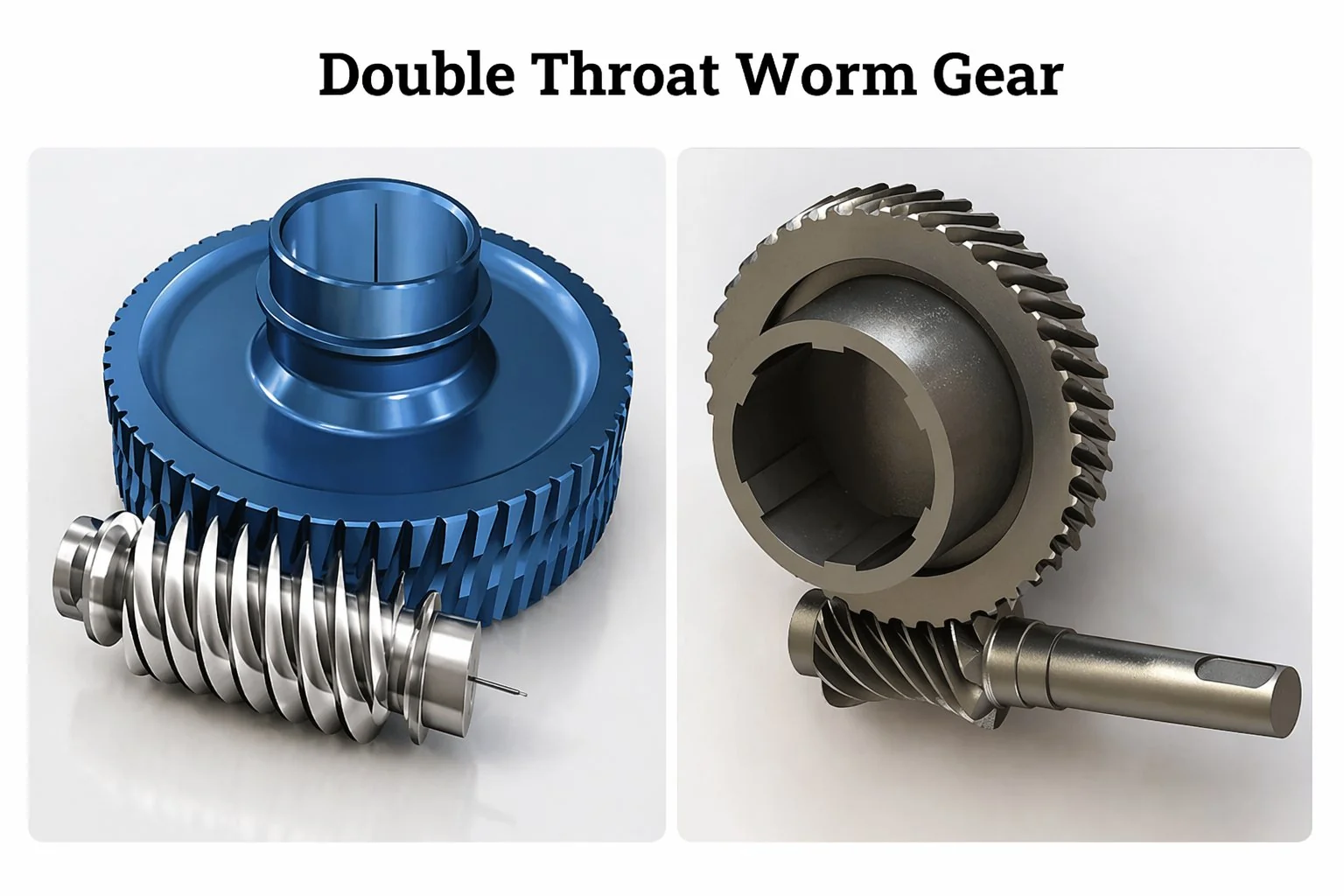
In a double-throat set, both components are throated. The worm itself takes on an hourglass shape — the diameter narrows in the middle of the worm body and widens toward both ends, allowing the wheel teeth to wrap around the worm contour. The wheel teeth are still throated as in the single-throat case, but the worm now wraps to meet them rather than presenting a flat cylindrical surface.
Six to eight teeth are in mesh simultaneously. Contact between the meshing surfaces is no longer a point or a line — it is a curved area of contact that follows the conjugate geometry of the two enveloping surfaces. Load capacity per unit envelope size is two to three times that of an equivalent single-throat set. This is the geometry of choice for the heaviest-duty drives where torque density is the binding constraint.
The cost penalty is real
Producing a double-throat (also called double-enveloping or globoidal) worm requires either a specialised hourglass-form thread grinder or a custom milling fixture that traces the conjugate envelope. The hob for the matching wheel teeth is non-standard for every ratio combination — it cannot be reused across different reduction ratios because the conjugate envelope shape changes. As a result, a double-throat set typically lists at 40 to 60 percent above an equivalent-size single-throat set, and the lead time runs 10 to 14 days longer for first articles where the tooling has to be made.
Once tooling exists for a given module and ratio, repeat orders run at standard lead time. So for a high-volume continuous production programme, the per-unit cost penalty of double-throat geometry shrinks meaningfully — the customer is amortising tooling cost over thousands of pieces. For one-off custom orders, the cost penalty stays painful.
When double-throat is genuinely the right answer
Heavy hoist drives lifting loads above 5 tonnes. Mining slurry conveyors operating 24 hours per day. Rolling mill auxiliary drives. Heavy military equipment turrets and stabilisers. Marine winches on offshore platforms. Aerospace control surface actuators where envelope size is constrained but torque is high. The common thread: the application is willing to pay the unit cost premium because the alternative — going to a larger single-throat set or a multi-stage helical reducer — would cost more or simply not fit the available envelope.
Side-by-side comparison
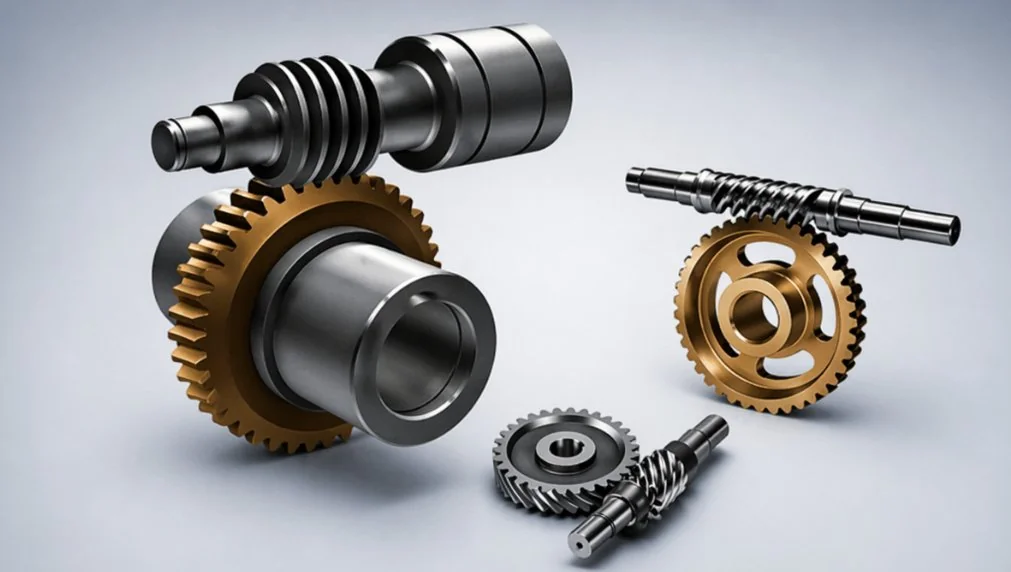
The numbers below are typical values our engineering desk uses when quoting against the three types. Cost and lead time figures are relative to the cheapest option (non-throat at module M3, ratio 30:1, which is the closest thing to an industry baseline) and reflect actual production reality at our Ansan facility. Other shops may show modestly different ratios, but the trend is consistent across the industry.
A simple decision tree
Spec a worm and worm wheel pair the way an experienced engineer does — by working three questions in order rather than starting from the catalogue.
Question 1: Is this an industrial drive carrying meaningful continuous load?
If no — small intermittent duty, prototype, instrument indexer — non-throat is on the table and probably the right cost choice. If yes, eliminate non-throat and proceed to Question 2.
Question 2: Is the duty cycle severe enough to justify a 50 percent cost premium?
If the drive runs 24 hours per day at high load, holds heavy lifted weights, or sits inside a constrained envelope where you cannot up-size to a bigger single-throat unit — double-throat earns its premium. Otherwise stay with single-throat.
Question 3: What accuracy class do you need?
Whichever throat type you pick, the accuracy class (DIN 5 / 6 / 7) is a separate decision. DIN 5 needs ground teeth, DIN 6 needs shaved teeth, DIN 7 hobbed-only is fine for general drives. Accuracy class drives 15 to 25 percent of unit cost depending on jump.
Three real misuse cases worth learning from
Case 1 — Double-throat where single-throat would have done the job
A Korean automation OEM specified double-throat geometry for a packaging-line indexer because the vendor’s salesperson described it as “the highest performance option.” Annual production volume was 2,400 units. The drive ran intermittently, perhaps 30 percent duty cycle, well within single-throat capacity. Net result: the customer paid an extra 28,000 USD per year in unit cost premium, accepted longer lead times during ramp-up, and gained zero performance benefit because they were not anywhere near the single-throat capacity ceiling. The lesson: do not specify capacity you will not use.
Case 2 — Non-throat used continuously instead of intermittently
A small machine-tool builder bought non-throat sets for a low-cost rotary indexer because the per-unit price was attractive. The duty cycle in the field turned out to be near-continuous — the indexer was running 18 hours per day in some customer shops. Wheel wear became visible at 3,000 hours. Failure happened at 5,000 hours. Warranty claims piled up. The customer ultimately switched to single-throat geometry, accepted the higher unit cost, and saw the warranty claim rate fall to nearly zero. The lesson: predict the actual duty cycle before specifying the cheapest type.
Case 3 — Single-throat asked to do double-throat work
A heavy hoist OEM scaled up an existing 3-tonne hoist design to a 6-tonne hoist by enlarging the worm wheel and keeping single-throat geometry. The original drive worked fine. The scaled version showed pitting on the wheel flank within the first 2,000 hours of field service. The geometry was at the edge of single-throat capacity, the dynamic shock loads pushed it over. The right answer would have been double-throat from the start — the cost premium would have been roughly 18 percent of total drive cost but would have eliminated the warranty exposure entirely. The lesson: when scaling up an existing design, the throat type that worked at the smaller size may not work at the larger one.
Frequently asked questions
Q: Is double-throat the same as double-enveloping?
Yes, the two terms describe the same geometry. “Double-throat” emphasises that both worm and wheel are throated; “double-enveloping” emphasises that each component envelopes the other. Some catalogues also use “globoidal” — same geometry again. All three terms are interchangeable in practice.
Q: Can I retrofit double-throat into a housing designed for single-throat?
Almost never, no. The hourglass worm shape requires more axial space than a cylindrical worm of equivalent ratio, and the bearing arrangement at the worm shaft ends usually has to be redesigned for the modified shaft profile. Centre distance can also change slightly. Treat throat type as a design-stage decision, not a retrofit option. If you are planning to upgrade a single-throat installation to handle higher loads, the practical paths are either a larger single-throat set in a redesigned housing, or a complete switch to a different ratio.
Q: Does throat type affect self-locking behaviour?
Self-locking is determined by lead angle, not throat type. A double-throat unit with a 4-degree lead angle self-locks just as a single-throat unit with the same lead angle does. Throat type affects load capacity and contact area; the lead angle is what determines whether the wheel can back-drive the worm. The two design parameters are independent.
Q: Why are non-throat worm gears even sold if they wear out faster?
Because for genuinely light-duty intermittent applications, the lower unit cost and shorter lead time outweigh the shorter service life. A non-throat unit running at 20 percent of rated capacity for 4 hours per day will still last 8 to 10 years before replacement — perfectly adequate for a guitar tuning peg, a printer feed mechanism, or a low-cost garden gate opener. Trying to use non-throat geometry for continuous industrial duty is the misuse, not the geometry itself.
Q: How do I tell which type I have on an existing drive?
Look at the worm shape first. If the worm body is a uniform cylinder along its full length — single-throat or non-throat. If the worm body is hourglass-shaped, narrow in the middle and wider at the ends — double-throat. Then look at the wheel teeth: if they are flat-cut across the wheel face — non-throat. If they are concave following the worm body — single-throat (with cylindrical worm) or double-throat (with hourglass worm). Three-second visual identification.
Q: Does throat type affect efficiency?
Slightly, yes — but not as much as lead angle does. Single-throat efficiency is typically 1 to 3 percentage points higher than non-throat at the same lead angle, because the load distribution across multiple teeth reduces specific contact pressure and therefore friction. Double-throat efficiency is similar to single-throat or marginally higher under heavy load conditions, but the difference is usually within measurement noise. If you are optimising for efficiency, change the lead angle (use multi-start worms), not the throat type. For a complete worm gear reducer in a packaged housing, the bearing and seal losses often dominate the total efficiency picture more than throat geometry does.
Q: What about backlash — is one throat type tighter than another?
Backlash depends primarily on tooth thickness tolerance and centre-distance accuracy, not on throat type. That said, double-throat geometry typically gives slightly tighter inherent backlash because the larger contact area reduces the gap any individual tooth presents at the engagement boundary. For zero-backlash precision applications (CNC C-axis, optical mounts), the right answer is a duplex worm — a single-throat set with axially shifting worm to take up backlash mechanically — rather than reaching for double-throat.
Once you have an answer to the three questions above, the throat-type decision is essentially made. Most industrial customers we work with land on single-throat geometry; a quarter end up with double-throat for heavy-duty applications; the small remainder pick non-throat for cost reasons on light intermittent drives. The honest framing is: pick the cheapest type that genuinely meets your duty cycle, and avoid the temptation to specify capacity you will not use.
If you have a drawing in hand and you are not sure which throat type fits the duty cycle, send it through to our engineering desk for a worm gear type recommendation. We will run the load and life calculation against the three options and tell you which one matches your application — including when the right answer is the cheaper geometry rather than the more sophisticated one. Standard catalogue ranges in single-throat and double-throat are stocked for the most common industrial modules; non-throat sets are made to order. The full single-throat and double-throat worm gear sets in bronze and alloy steel are documented with parameter tables and price tiers on the catalogue page.
Not sure which throat type fits your application?
Send your output torque, duty cycle, and required service life. We will run the three-throat comparison against your specific numbers and recommend the geometry that does the job at the lowest landed cost.
Editor: Cxm