Schneckengetriebeschmierung – Die Wahl des richtigen Öls für Bronzeräder
EP additives and yellow metal coexist uneasily. Pick the wrong oil chemistry and the bronze wheel pits in 2,000 hours instead of 30,000. Here is how to get it right.
For a standard industrial worm and worm wheel pair running below 70 degrees Celsius sump temperature, ISO VG 460 or 680 compounded mineral oil with yellow-metal-safe additives is the safe default. Above 70 degrees Celsius, switch to PAO synthetic at the same viscosity grade. For high-efficiency continuous duty, polyglycol (PAG) at one ISO grade lower (VG 320 or 460) cuts heat generation noticeably — but PAG is incompatible with mineral and PAO, so changing requires complete drain and flush. The single most expensive lubrication mistake is using GL-5 hypoid oil or generic differential oil on a bronze wheel — sulphur-phosphorus EP additives corrode yellow metals above 70 degrees Celsius and destroy a worm wheel in weeks.
The central conflict: EP additives versus yellow metal
Almost every other type of gear oil article puts viscosity tables at the top and treats additive chemistry as an afterthought. For worm and worm wheel pairs that order is wrong. The single decision that does the most damage when made carelessly is the additive package, not the viscosity grade. Get the additives right and almost any sensible viscosity will give acceptable service life. Get the additives wrong and even a perfectly chosen viscosity will destroy the bronze wheel in months.
The conflict is straightforward. Sliding contact between worm and wheel needs extreme-pressure additives — chemically active compounds that form a sacrificial protective film on the metal surface under high contact stress. The classic EP chemistry uses sulphur and phosphorus compounds that activate at elevated temperatures. On a steel-on-steel gear (most automotive differentials, hypoid axle drives), these additives work perfectly. On a steel-worm-on-bronze-wheel pair — which is the standard industrial configuration — the activated sulphur attacks the copper in the bronze, causing tarnishing, micro-pitting, and eventually surface metal loss. The wheel does not seize dramatically; it slowly corrodes from the contact surface inward, losing tooth profile and accuracy until the drive becomes unusable.
The conflict is real, the consequences are expensive, and the avoidance is straightforward — choose oils explicitly labelled “yellow metal safe” or “compounded for worm gears” or “deactivated sulphur EP additive package.” Modern formulations from major suppliers solve the problem; generic catalogue gear oils may or may not. Always check the technical data sheet before committing to a fill.
Three oil chemistries that work for worm gears
Across thousands of worm and worm wheel installations, three lubricant chemistries account for almost all successful applications. Each has strengths, weaknesses, and a specific operating window where it is the right answer.
The choice is rarely subtle once the application is defined. Mineral compounded oil for ordinary industrial duty under 70 degrees Celsius. PAO synthetic for higher temperatures or extended drain intervals. PAG (polyglycol) for maximum efficiency on high-duty continuous applications. Mixing categories is where most maintenance accidents happen.
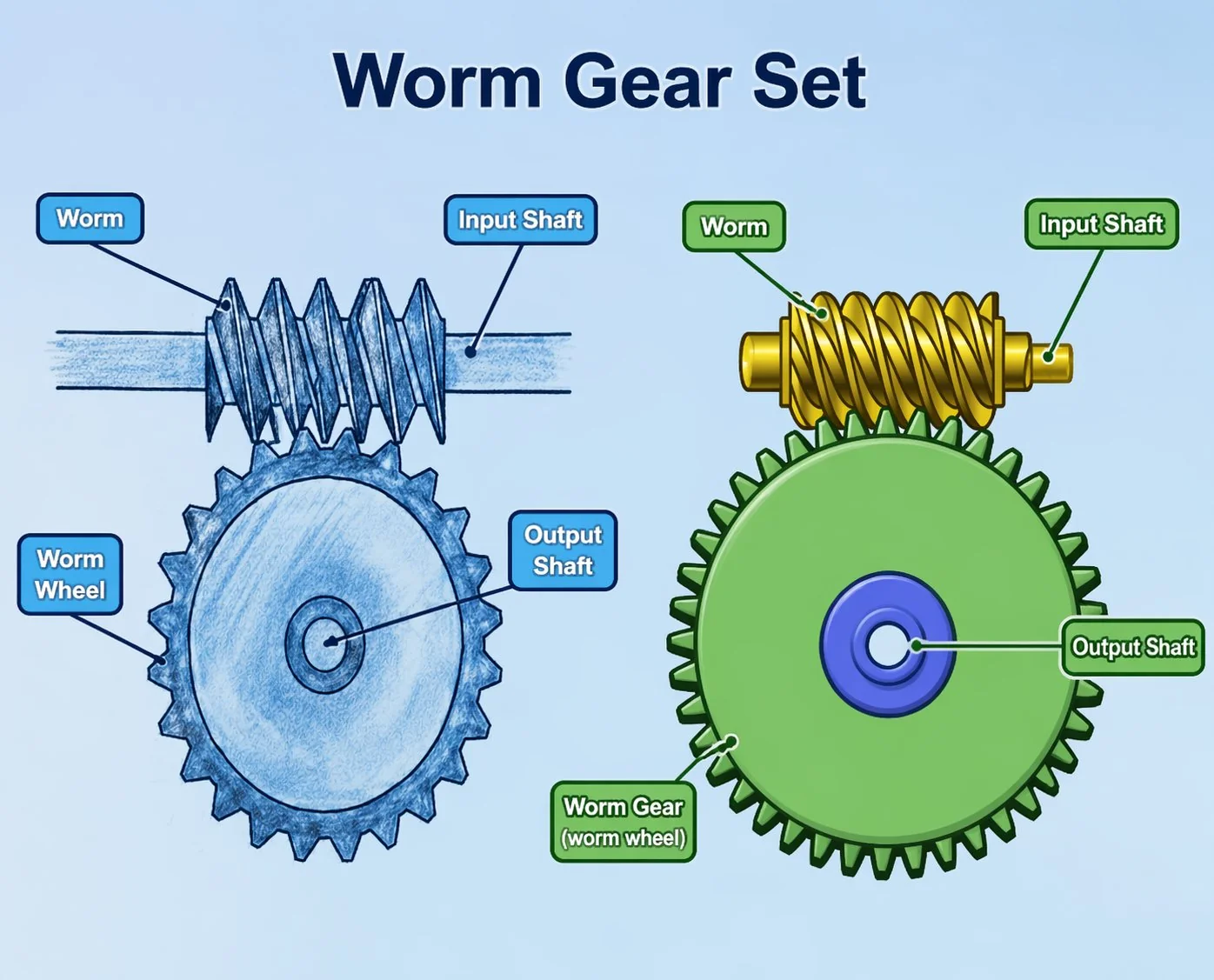
Compounded mineral oil — the industrial default
Mineral base oil with 4 to 10 percent fatty acid (acidless tallow or synthetic equivalent) blended in as the compounding agent, plus rust and oxidation inhibitors. The fatty acid component delivers boundary lubrication directly without relying on chemically active EP additives, which sidesteps the yellow metal corrosion risk entirely. Compounded mineral oils are the original worm gear lubricant — the formulations have been refined for over a century.
Operating window: ambient temperatures down to roughly minus 5 degrees Celsius, sump temperature up to 80 degrees Celsius. Above 80 degrees the fatty acid begins to oxidise and the lubricant degrades faster than the recommended drain interval can keep up with. Below freezing, the oil is too viscous to splash properly during start-up. Drain interval is typically 4,000 to 6,000 hours of operation in normal industrial duty. Cost is the lowest of the three categories — compounded ISO VG 460 mineral runs roughly half the price of equivalent-grade synthetic.
PAO synthetic — for higher temperatures and extended drain
Polyalphaolefin base oil — a synthetic hydrocarbon — with milder modern EP additives that are typically yellow-metal-safe in their commercial formulations. PAO has higher viscosity index than mineral oil, which means the viscosity changes less over the operating temperature range. It also has better thermal stability — drain intervals at the same sump temperature are typically twice as long as mineral compounded oil.
Operating window: ambient down to minus 30 degrees Celsius, sump temperature up to 100 to 110 degrees Celsius. Drain interval 8,000 to 12,000 hours. PAO is fully compatible with mineral oil — switching from mineral to PAO does not require a flush, only a top-up at the next change. Cost roughly 2 to 3 times mineral compounded oil per litre. PAO is the right choice when sump temperature exceeds 70 degrees during normal operation, when ambient extremes (cold winter starts, hot summer afternoons) cause viscosity drift, or when extending drain interval pays back through reduced labour cost.
PAG polyglycol — for maximum efficiency
Polyalkylene glycol — a different family of synthetic chemistry that is fundamentally not a hydrocarbon. PAG has the lowest coefficient of friction of any common gear oil chemistry, which translates directly into measurable efficiency gains on worm and worm wheel pairs. A drive that runs at 60 percent efficiency on mineral oil typically gains 3 to 6 percentage points on PAG, and the operating sump temperature drops 15 to 20 degrees Celsius for the same load. For continuous-duty applications running multiple shifts, those gains compound into meaningful electricity savings.
Operating window: ambient down to minus 40 degrees Celsius, sump temperature up to 130 degrees Celsius. Drain interval 16,000 to 20,000 hours — longest of the three categories. The catch: PAG is incompatible with mineral oil and PAO synthetic. Mixing them creates a sludge that clogs the gearbox internals. Switching from a hydrocarbon-based oil to PAG requires complete drain, two flushes with light oil, and refill — typically a one-day maintenance event for a sealed gearbox. PAG also attacks some seal materials (nitrile, certain polyurethanes) and most paint coatings, so the gearbox seals must be PAG-compatible before the switch. Cost roughly 4 to 6 times mineral compounded oil per litre.
When a customer tells me they want to switch from mineral compounded oil to PAG, the first question I ask is whether they have the maintenance discipline to do it properly. PAG can extend drain intervals dramatically and cut electricity bills measurably — but only if the conversion is done with full drain and double flush. Half-converted gearboxes (someone topped up PAG into a sump that still had a few litres of residual mineral) form sludge within weeks and the entire fill has to be redone. For low-discipline maintenance environments, sticking with PAO is often the wiser choice even though it costs more in lubricant alone — the operational risk of contamination is significantly lower.
Viscosity selection — ISO VG and AGMA cross-reference
Once the chemistry is decided, viscosity is the second decision. Worm gear viscosities are heavier than most other gear oils because the sliding contact requires a thicker hydrodynamic film than rolling contact would.
ISO VG 460 and 680 are the workhorses for industrial worm and worm wheel pairs. ISO VG 220 appears in low-load light-duty drives. ISO VG 1000 (or AGMA 8A compound) appears in heavily loaded large-centre-distance industrial reducers running at low rpm.
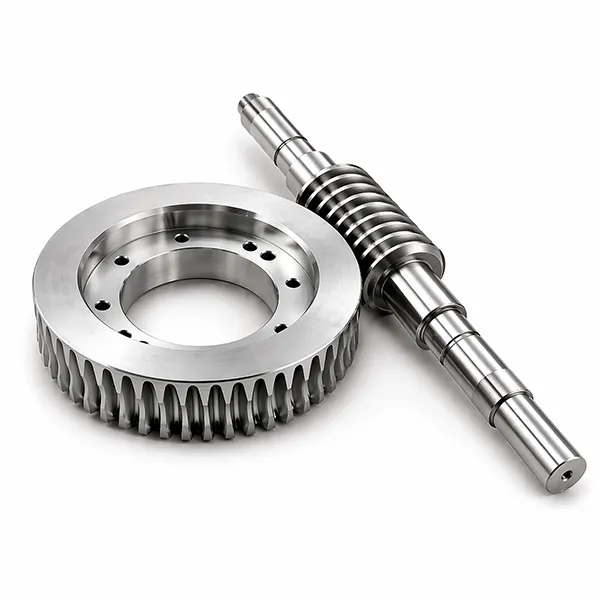
Two practical rules cover most viscosity decisions. First, when switching from mineral oil to a synthetic with higher viscosity index, drop one ISO grade — a mineral VG 680 is roughly equivalent in operating-temperature viscosity to a PAO VG 460 or a PAG VG 320. Second, lean toward higher viscosity at higher ambient temperature and higher load, lower viscosity for cold start-up and high-speed drives. Splitting the difference (start with mineral VG 460 for almost any general industrial drive) is fine for the first fill — adjust based on observed sump temperature and oil condition at the first drain.
Temperature-driven decision tree
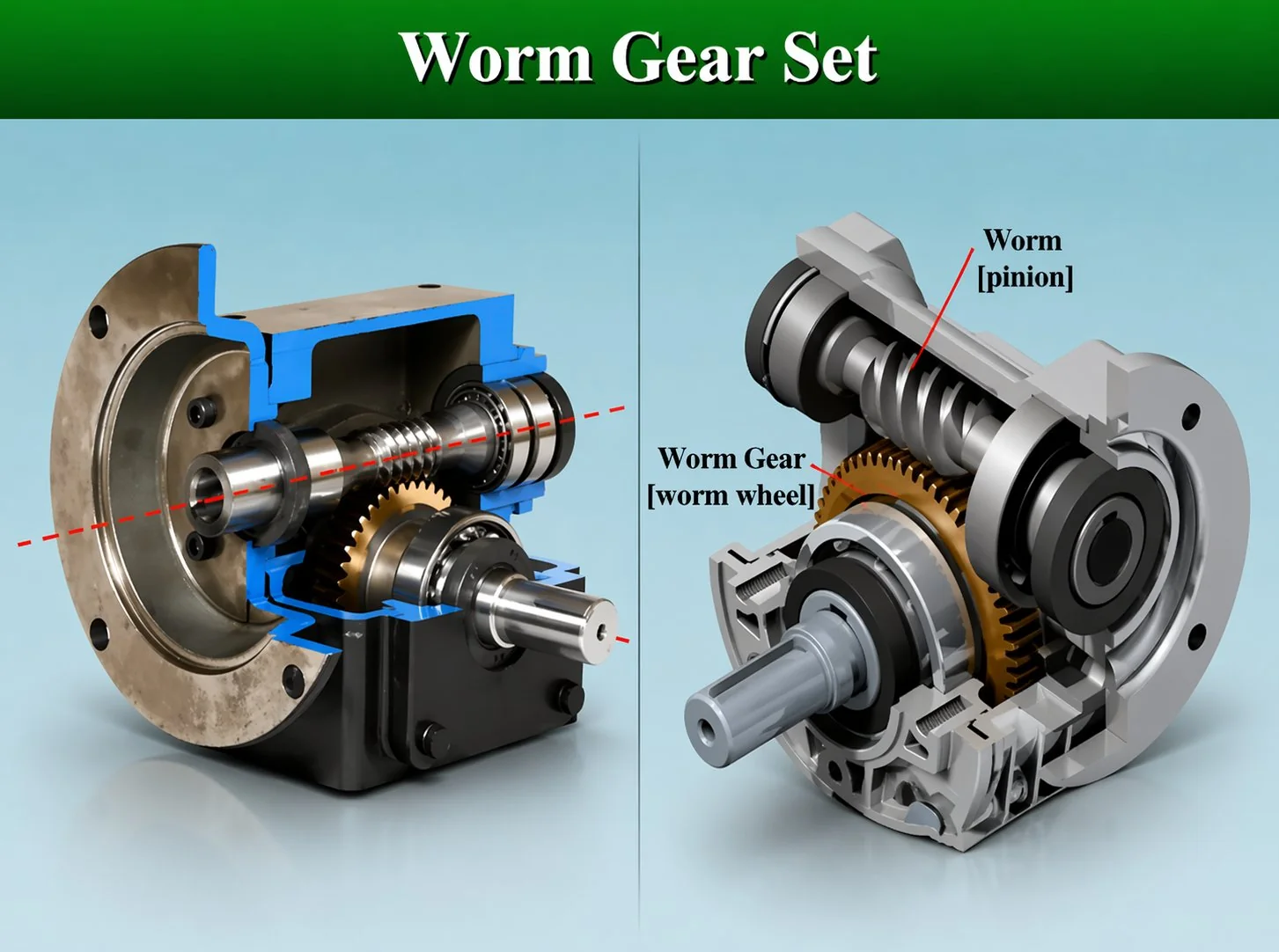
Ambient and sump temperature are the two variables that drive the chemistry decision more than any other. A simple decision tree settles the choice in three questions.
Question 1: What is the steady-state sump temperature at full load?
Below 70 degrees Celsius → compounded mineral oil is fine. Between 70 and 90 degrees → switch to PAO synthetic. Above 90 degrees → PAG polyglycol or supplementary cooling required.
Question 2: How many hours per day does the drive run?
Less than 8 hours intermittent → mineral compounded covers it economically. 8 to 16 hours per day → PAO if sump is warm, mineral if it stays cool. 16 hours or more continuous → PAG pays back through electricity savings within 18 months on most installations.
Question 3: Will sump temperature swing more than 60 degrees Celsius between cold start and full operation?
Yes (outdoor installations, unheated facilities, winter starts) → synthetic strongly preferred for the higher viscosity index. PAO is the safe choice. PAG is even better but only worthwhile if continuous duty justifies the cost.
Three real lubrication failure cases
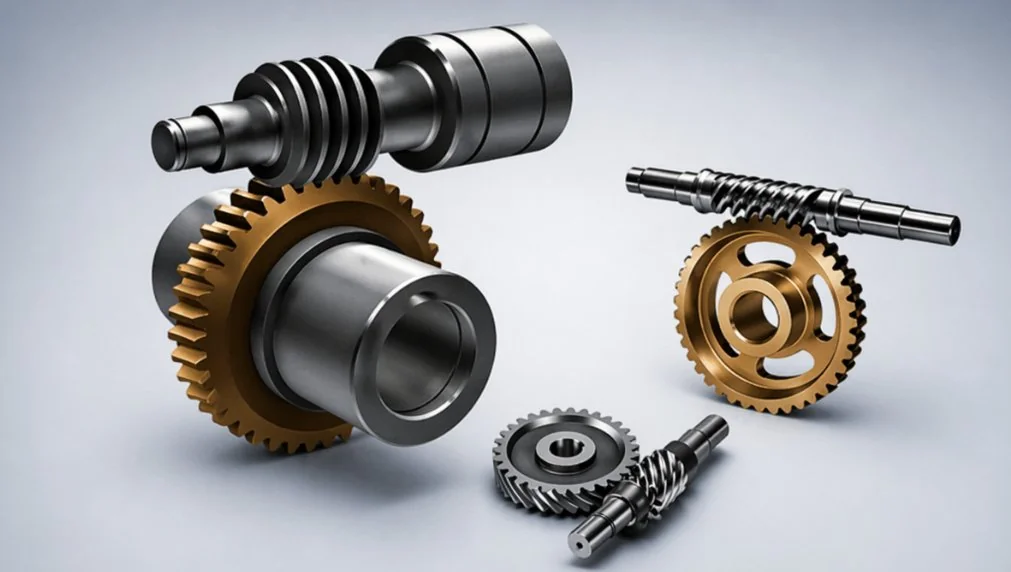
Three failure modes appear repeatedly in field reports we receive from customers asking for replacement components. Each is preventable, each is expensive, and each was caused by a maintenance decision that overlooked one of the principles described in the sections above. Understanding these patterns helps avoid them on your own equipment.
Case 1 — GL-5 differential oil in a bronze worm wheel
A small Vietnamese conveyor builder topped up the gearbox sumps on their assembly line with API GL-5 hypoid axle oil — same ISO viscosity grade as the original specification, much cheaper per litre, sitting on the maintenance shelf because the same shop also serviced trucks. Within three months, the bronze wheels showed surface tarnishing visible through the inspection port. By month six, tooth flank pitting was severe enough that drive efficiency had dropped 8 percent and operating noise had climbed audibly. Diagnosis: GL-5 contains aggressive sulphur-phosphorus EP additives that activate above 70 degrees Celsius, and the bronze wheels were running at 75 to 80 degrees. The active sulphur attacked the copper, produced black copper sulphide flakes, and corroded the wheel tooth surface from the contact zone outward. Solution: drain, flush with light mineral oil, refill with proper compounded ISO VG 460 yellow-metal-safe gear oil. Wheels needed replacement; the savings on cheap differential oil cost the customer fifteen times the original gearbox replacement cost in warranty claims.
Case 2 — Half-converted PAG fill
A Korean food packaging plant decided to upgrade from mineral compounded ISO VG 460 to PAG ISO VG 320 to extend drain intervals on its shift-running line. The maintenance team drained the sumps, refilled with PAG, and ran the line. Within two weeks, the gearbox sumps showed visible sludge — a brown gelatinous deposit floating on top of the PAG fill. Drive efficiency had dropped, sump temperature had climbed 15 degrees above expected, and one gearbox seal had started weeping. Diagnosis: residual mineral oil left in the sump after the initial drain (typically 5 to 10 percent of fill volume sticks to internal surfaces and bearing pockets) had reacted with the PAG, forming the characteristic incompatibility sludge. The conversion procedure had skipped the flush step. Solution: complete second drain, flush with PAG-compatible flushing oil, refill with fresh PAG, replace the affected seals. The lesson: switching from hydrocarbon to PAG requires drain → flush → refill, never just drain → refill.
Case 3 — Underfilled vertical-mount gearbox
A Japanese mixer manufacturer bought standard horizontal-mount worm gearboxes and installed them on vertical agitator shafts without changing the oil-fill level. The fill volume specified for horizontal mounting submerged the worm to roughly 30 percent of its diameter — appropriate for splash lubrication. With the gearbox rotated 90 degrees, the same fill volume left the worm only 5 percent submerged at startup. Within the first month, the wheel teeth showed scuffing on one side. Diagnosis: insufficient oil immersion in the vertical orientation meant the worm thread did not pick up enough oil to create a proper hydrodynamic film at start-up. The drive ran in boundary lubrication conditions during every cold start. Solution: top up the fill level to the supplier-specified vertical-mount mark, and confirm the breather and oil level sight glass were positioned correctly for the new orientation. The lesson: oil level matters as much as oil chemistry, and changing mounting orientation always changes the correct fill volume.
Frequently asked questions
Q: Can I use motor oil or hydraulic oil in a worm gearbox in an emergency?
Only for the shortest possible duration to limp the equipment to a maintenance shutdown. Motor oil and hydraulic oil lack the viscosity and the boundary lubrication additives needed for sliding-contact gearing. Running on either fluid for more than a few hours under load will scuff the bronze wheel. If the original lubricant is unavailable in the field, ISO VG 220 or higher hydraulic oil is less bad than ISO VG 32 hydraulic oil. Do not extend an “emergency fill” beyond the next scheduled service window.
Q: How do I know if my oil is yellow-metal-safe?
Check the technical data sheet for ASTM D130 copper strip corrosion test results. A rating of 1A or 1B means yellow-metal-safe and suitable for bronze worm wheels. A rating of 2 or higher is borderline. A rating of 3 or 4 means the oil will corrode bronze under normal operating temperatures and should not be used. Most modern industrial worm gear oils explicitly list “1B at 121°C” or similar in the data sheet — if the data sheet is silent on copper compatibility, treat the oil as suspect.
Q: What is the difference between compounded oil and EP gear oil?
Compounded oil uses fatty acid (typically 4 to 10 percent acidless tallow or synthetic equivalent) blended into the mineral base oil to provide lubricity directly. EP gear oil uses chemically active additives (sulphur, phosphorus, borates) that react with the metal surface under high contact pressure to form a sacrificial film. For bronze worm wheels, compounded oil is inherently safer because there is no chemically active additive that could corrode the yellow metal. Modern EP gear oils with deactivated sulphur are also safe, but the safety depends entirely on the formulation — compounded oil is the more conservative default.
Q: How often should the oil be changed?
Drain interval depends on chemistry, sump temperature, and duty cycle. Typical numbers: mineral compounded oil 4,000 to 6,000 operating hours, PAO synthetic 8,000 to 12,000 hours, PAG polyglycol 16,000 to 20,000 hours. Sump temperature halves all of these numbers above 90 degrees Celsius (Arrhenius rule — chemical degradation roughly doubles for each 10 degrees Celsius). For critical equipment, oil analysis every 1,000 to 2,000 hours gives a more accurate condition-based interval than calendar-based replacement.
Q: Does grease ever replace oil in a worm gearbox?
In small sealed-for-life drives, yes — most automotive seat actuators, household appliance timers, and small DC-motor driven worm gear units use lithium-soap thickened PAO grease for life. The trade-off: grease does not migrate around the gearbox the way oil does, so heat dissipation is poor and load capacity is lower. For industrial drives above 1 kW, oil is the right answer; for micro-actuators below 50 W, grease is usually preferable for sealing simplicity.
Q: Are food-grade lubricants compatible with bronze worm wheels?
NSF H1 registered lubricants for incidental food contact come in compounded mineral and PAO synthetic versions, both formulated to be yellow-metal-safe. Performance is somewhat compromised relative to industrial-grade equivalents because the additive choice is restricted by FDA regulations — H1 oils have shorter drain intervals and lower load capacity than equivalent industrial grades. For pharmaceutical and food applications using stainless-on-stainless worm and worm wheel pairs, this trade-off is acceptable; for bronze wheel pairs in regulated environments, it is generally cheaper to switch to stainless components and gain regulatory compliance with no efficiency penalty.
Q: How does oil choice affect a complete worm gear reducer versus a bare gear set?
For a bare gear set installed in a customer-built housing, the customer chooses and adds the lubricant — and must take responsibility for additive compatibility with bronze. For a complete Schneckengetriebe shipped pre-filled, the supplier has already specified and added the right oil at the factory, and the data sheet on the unit should match the lubricant inside. When ordering a packaged reducer, always confirm the lubricant grade on the nameplate matches the order specification — substitutions occasionally happen during production, and the maintenance team needs to know what is actually in the sump for the next change.
The single message worth carrying away from this article is the importance of additive chemistry over viscosity grade. A worm and worm wheel pair will tolerate a one-grade viscosity error and lose only a few percent of efficiency. The same drive will not tolerate the wrong additive package — getting that wrong destroys the bronze wheel measurably faster than any other maintenance error. Always specify yellow-metal-safe oil. Always check the data sheet before changing brands. Always full-drain-and-flush before switching between mineral, PAO, and PAG categories. And always confirm sump fill level against the actual mounting orientation, not the catalogue default.
For Korean and Japanese OEM design teams that want a lubricant specification matched to a specific drive geometry and duty cycle, our engineering desk recommends an oil chemistry, viscosity, and drain interval against the actual operating profile. Standard catalogue phosphor bronze and aluminium bronze worm gear sets ship with a recommended fill specification — request a lubrication specification review if your operating temperature, duty cycle, or environment differs from the catalogue assumption.
Not sure if your current gear oil is bronze-safe?
Send the oil brand and product code, the gearbox sump temperature, and the duty cycle. We will check the additive package against your wheel material and recommend a replacement if the current fill is putting the bronze at risk.
Herausgeber: Cxm