Korea Ever-Power · Application Engineering Guide
Šnek a šnekové kolo pro pohony kol AGV a AMR
An AGV wheel drive must fit inside a 120 mm chassis height, weigh under 2 kg, produce 80 N·m at the wheel, run quieter than 55 dB(A) in a hospital corridor, and park on a 5-degree ramp without rolling backward — all from a 48 V battery pack. The worm gear pair is the only gear type that delivers compact 90-degree layout plus self-braking in a single stage. Whether the efficiency penalty is acceptable depends on one number: how many kilometres per battery charge does the application actually need.
Worm gear pairs compete against planetary and harmonic drives for AGV and AMR wheel applications. The worm pair wins on three dimensions — compact 90-degree layout (30 to 50 percent shorter axial depth than inline planetary), inherent self-braking on slopes (no separate parking brake needed), and lower unit cost (typically 40 to 60 percent less than planetary at the same torque). The worm pair loses on one critical dimension — efficiency (45 to 65 percent versus 90 to 95 percent for planetary), which directly reduces battery range by 30 to 50 percent compared to a planetary-equipped vehicle. The decision therefore depends on the application mission profile: short-range warehouse AGVs with frequent charging (under 2 km per charge cycle) tolerate worm gear efficiency; long-range hospital delivery robots or outdoor logistics AMRs (over 5 km per cycle) typically cannot. Plastic worm wheels (MC Nylon or POM) reduce noise to 45 to 50 dB(A) and weight by 40 percent versus bronze — suitable for hospital and cleanroom AGVs where noise and contamination matter more than service life.
Why AGV and AMR designers consider worm gear pairs
Automated Guided Vehicles and Autonomous Mobile Robots are battery-powered platforms that carry payloads across factory floors, warehouses, hospitals, and logistics centres. The wheel drive — typically one or two driven wheels plus passive castors — needs a gear reduction between the compact BLDC motor and the drive wheel. Three gear types compete for this application, and each has a different strength profile.
The motor mounts perpendicular to the wheel axle, fitting within the chassis height rather than extending behind it. A 200 W BLDC motor with a worm gear pair fits in a 100 × 80 × 65 mm envelope — roughly half the axial depth of an inline planetary at the same ratio and torque.
A single-start worm gear pair with lead angle below 5 degrees is geometrically self-locking. The AGV parks on a ramp without needing a separate electromagnetic or mechanical parking brake — saving weight, wiring, and a potential failure mode.
A worm gear pair at module 1.5, centre distance 40 mm, ratio 20:1 costs approximately 25 to 45 USD at production volume. The equivalent planetary gearbox costs 80 to 150 USD. For an AGV manufacturer building 500 to 2,000 units per year, the per-unit cost difference is significant.
These three advantages make the worm and worm wheel the default starting point for many AGV wheel drive designs — especially in the Korean and Chinese markets where AGV platforms compete aggressively on cost. The question is whether the efficiency penalty eliminates the advantages for a given mission profile.
Worm gear vs planetary vs harmonic — side-by-side for AGV wheel drives
The table below compares the three gear types at a common AGV specification point: 80 N·m output torque, 20:1 ratio, 150 mm wheel diameter, 1.0 m/s travel speed. This is a typical Korean e-commerce warehouse AGV carrying a 500 kg payload.
Every number in the table is for the gear stage only — motor, controller, and battery are identical across all three options. The comparison isolates the gear selection decision.
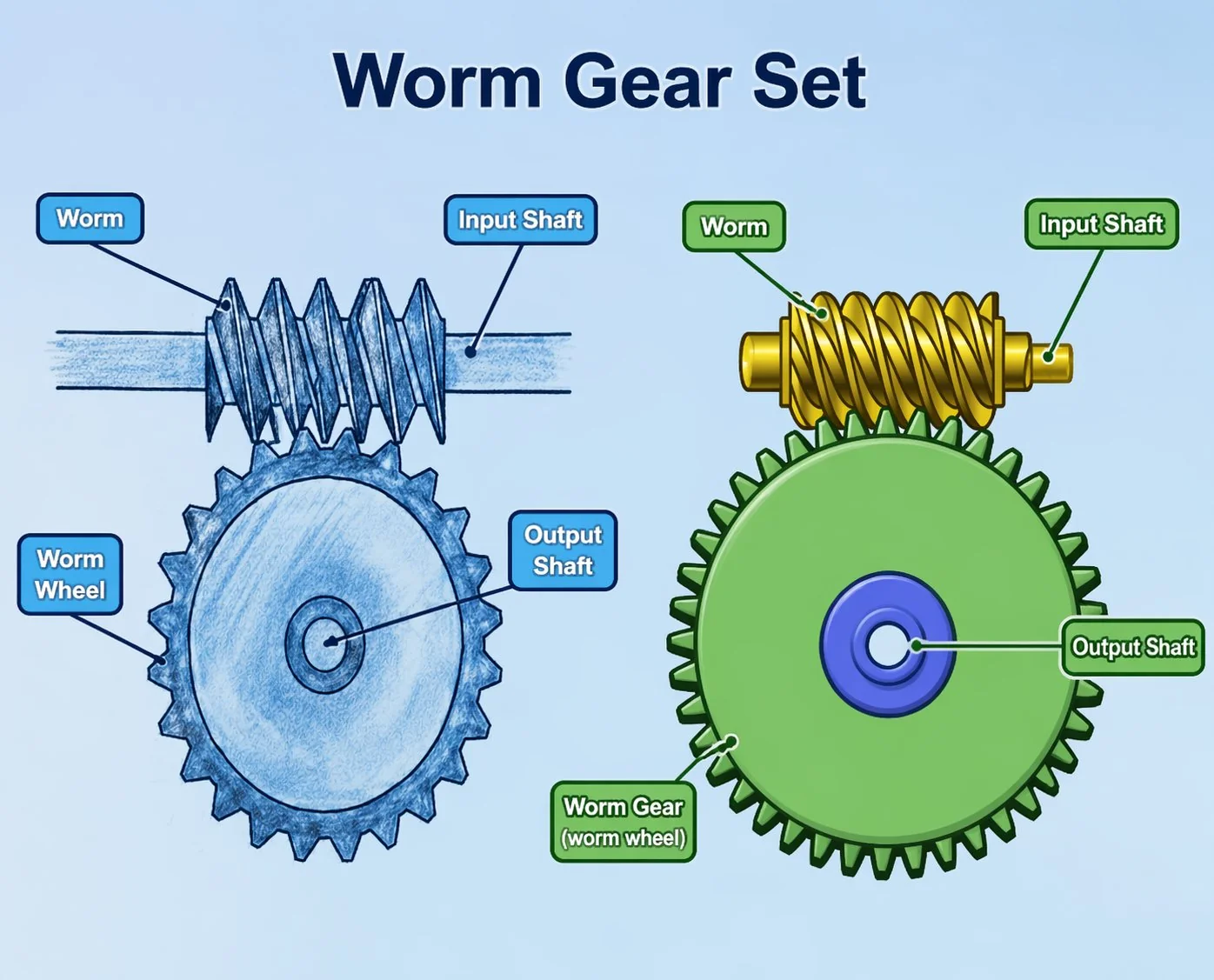
Reading the table. The worm gear pair wins on 5 of 9 parameters (envelope, axial depth, weight, self-braking, noise, cost) but loses decisively on efficiency and battery range. The planetary wins on efficiency and battery range but loses on axial depth and self-braking. The harmonic wins on backlash and axial depth but loses on cost. No gear type wins every parameter — the selection is always a trade-off weighted by the specific AGV mission.
Battery range impact — quantifying the efficiency penalty
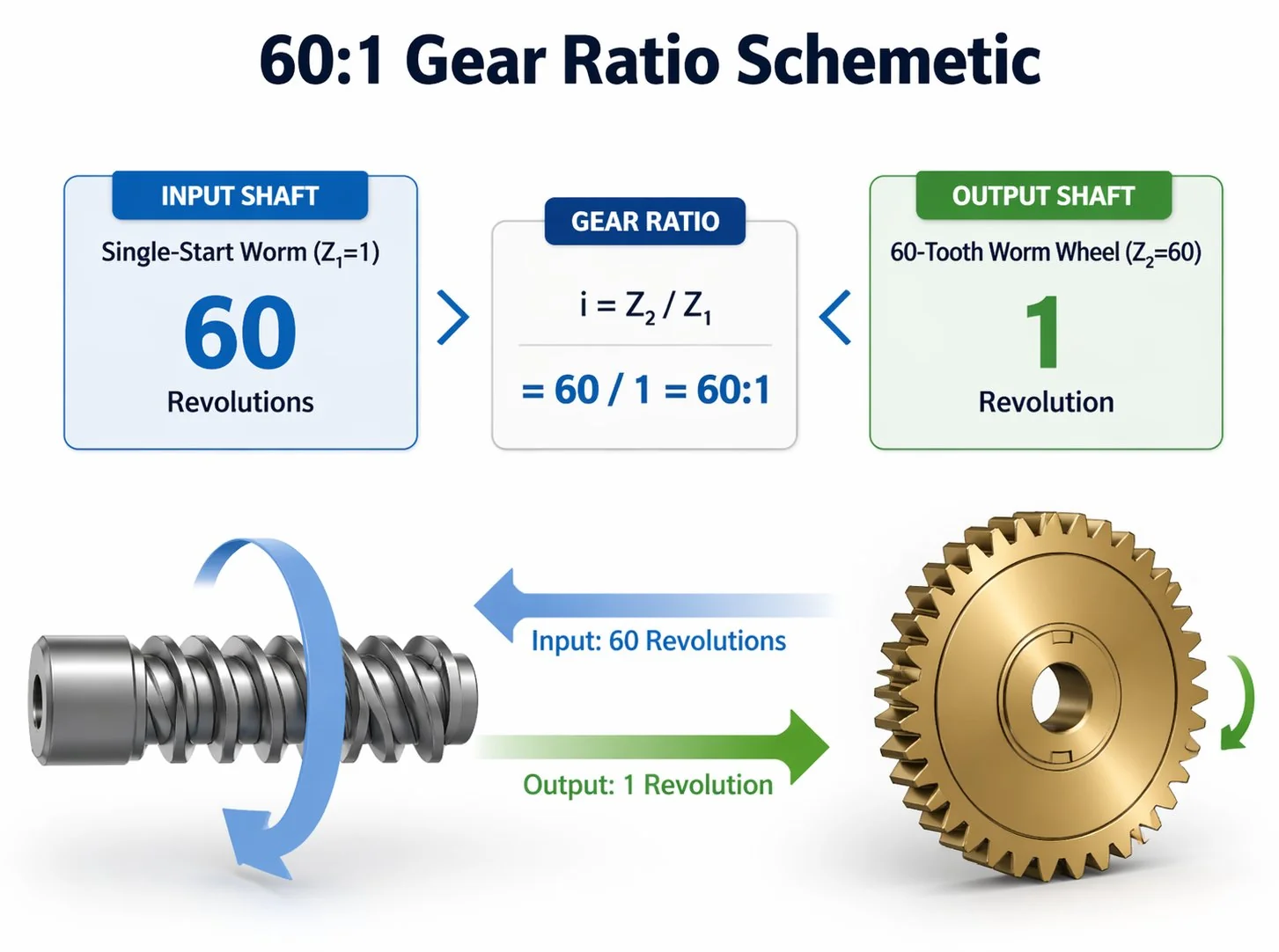
The worm gear efficiency penalty is not abstract — it translates directly into shorter battery range and more frequent charging. For a battery-powered AGV, every watt lost in the gear stage is a watt drawn from the battery that produces no useful traction.
Worked example. A 500 kg payload AGV with 150 mm drive wheels, 200 W BLDC motors, 48 V / 20 Ah battery (960 Wh). At 1.0 m/s travel speed on a level floor, the traction power required at the wheel is approximately 80 W (rolling resistance + payload friction). With a 55 percent efficient worm gear pair, the motor draws 80 / 0.55 = 145 W from the battery. With a 92 percent efficient planetary, the motor draws 80 / 0.92 = 87 W. The battery supplies 960 Wh total. At 145 W draw (worm), continuous range = 960 / 145 = 6.6 hours = roughly 24 km. At 87 W draw (planetary), range = 960 / 87 = 11.0 hours = roughly 40 km. The worm-equipped AGV achieves 60 percent of the planetary-equipped range — a 40 percent reduction.
When the penalty is acceptable. Many Korean warehouse AGVs operate in short-circuit patterns: pick station to packing station, 50 to 200 metres per trip, 8 to 12 trips per hour, with opportunity charging at the pick station during each dwell. Total travel per charge cycle: 1 to 3 km. At this short range, the 24 km worm-gear range is more than adequate — the AGV charges more frequently but never approaches its range limit. The 55 to 105 USD cost saving per unit on the gear stage (worm vs planetary) × 1,000 units per year = 55,000 to 105,000 USD annual saving on hardware alone. This is the economic case for worm gear AGV drives in short-range warehouse applications.
When the penalty is unacceptable. Hospital delivery robots covering 5 to 15 km per charge cycle across multiple floors with elevator transitions, outdoor logistics AMRs traversing factory campuses at 3 to 8 km per cycle, and long-corridor airport AGVs all need the full battery range that only 90+ percent efficient planetary or harmonic drives can deliver. For these missions, the worm gear cost advantage is overwhelmed by the battery capacity cost of compensating for the efficiency loss.
A Korean e-commerce fulfilment centre deployed 120 shelf-carrying AGVs with worm gear wheel drives in 2024. The AGVs operated on a flat warehouse floor with a maximum ramp gradient of 3 degrees at the charging station approach. Mission profile: 80 to 120 metres per trip, 10 trips per hour, opportunity charging during 15-second shelf pickup dwell time. Total travel per charge cycle: 1.2 km average. The worm gear pair specification: single-start, module 1.5, centre distance 35 mm, ratio 20:1, MC Nylon wheel (noise requirement: less than 52 dB(A) for night-shift operation next to a residential area). Efficiency at rated load: 52 percent. Battery: 48 V / 10 Ah (480 Wh) — a compact pack that fits the narrow chassis. Range at 52 percent gear efficiency: 8 km — roughly 6.7 times the 1.2 km mission requirement. The self-braking feature eliminated the need for 120 electromagnetic parking brakes at 35 USD each — saving 4,200 USD on the fleet. Total gear stage cost saving versus planetary: 120 units × 65 USD per unit = 7,800 USD. Combined hardware saving (gear + eliminated brakes): 12,000 USD on a 120-unit fleet. Six months of operation confirmed: zero range anxiety events, zero slope-rollback incidents, noise measured at 48 dB(A) at 1 metre — below the 52 dB(A) night-shift limit. The worm gear pair was the correct choice for this specific mission profile. For a different mission — longer range, more floors, outdoor terrain — it would not have been.
Plastic worm wheels for ultra-low noise AGV and hospital robot drives
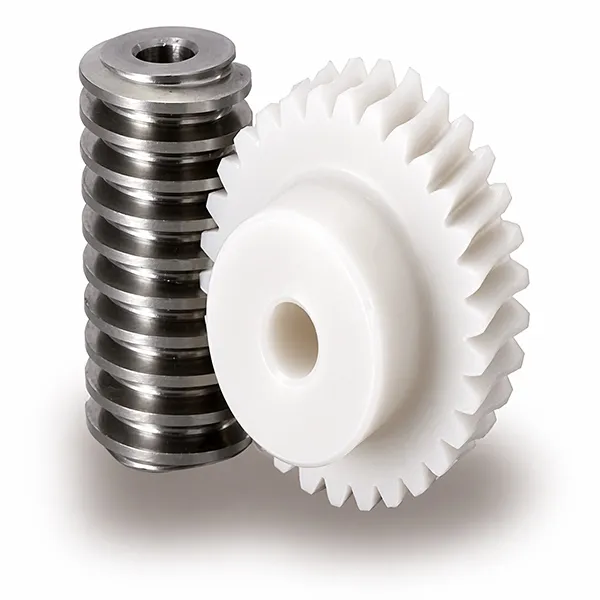
Hospital delivery robots, cleanroom AGVs, and office-environment AMRs face noise limits as low as 45 dB(A) at 1 metre — quieter than a normal conversation. Bronze worm wheels meshing against steel worms produce 55 to 65 dB(A) even at small AGV sizes. Plastic worm wheels bring the noise down to 45 to 50 dB(A) through material damping.
Two plastic materials dominate AGV worm wheel production: MC Nylon (cast polyamide 6) and POM (polyoxymethylene, acetal). Each has distinct strengths for mobile robot applications.
Noise: 45-50 dB(A) at 1 m — excellent damping.
Hmotnost: 40% lighter than bronze at same dimensions.
Mazání: Can run dry at light loads (self-lubricating).
Limit: Temperature max 80°C, absorbs moisture (dimensional change 1-2%). Not suitable for continuous heavy loads above 30 N·m output.
Best for: Hospital robots, cleanroom AGVs, light-payload shuttles.
Noise: 48-53 dB(A) at 1 m — good damping.
Hmotnost: 35% lighter than bronze.
Mazání: Excellent dry-running properties, low friction coefficient.
Limit: Lower impact resistance than MC Nylon. Temperature max 90°C. Not suitable for shock loads.
Best for: Warehouse AGVs, office AMRs, moderate-payload continuous duty.
The trade-off against bronze is service life: a plastic worm wheel in an AGV application typically lasts 3,000 to 8,000 operating hours versus 15,000 to 25,000 hours for bronze. At a typical AGV duty of 3,000 hours per year, the plastic wheel needs replacement every 1 to 2.5 years while the bronze wheel lasts 5 to 8 years. However, the plastic wheel costs 3 to 8 USD versus 15 to 30 USD for bronze, and the replacement takes 15 minutes on a modular AGV drive unit — making the total lifecycle cost comparable while delivering superior noise performance throughout.
Three AGV and AMR worm gear pair specification cases
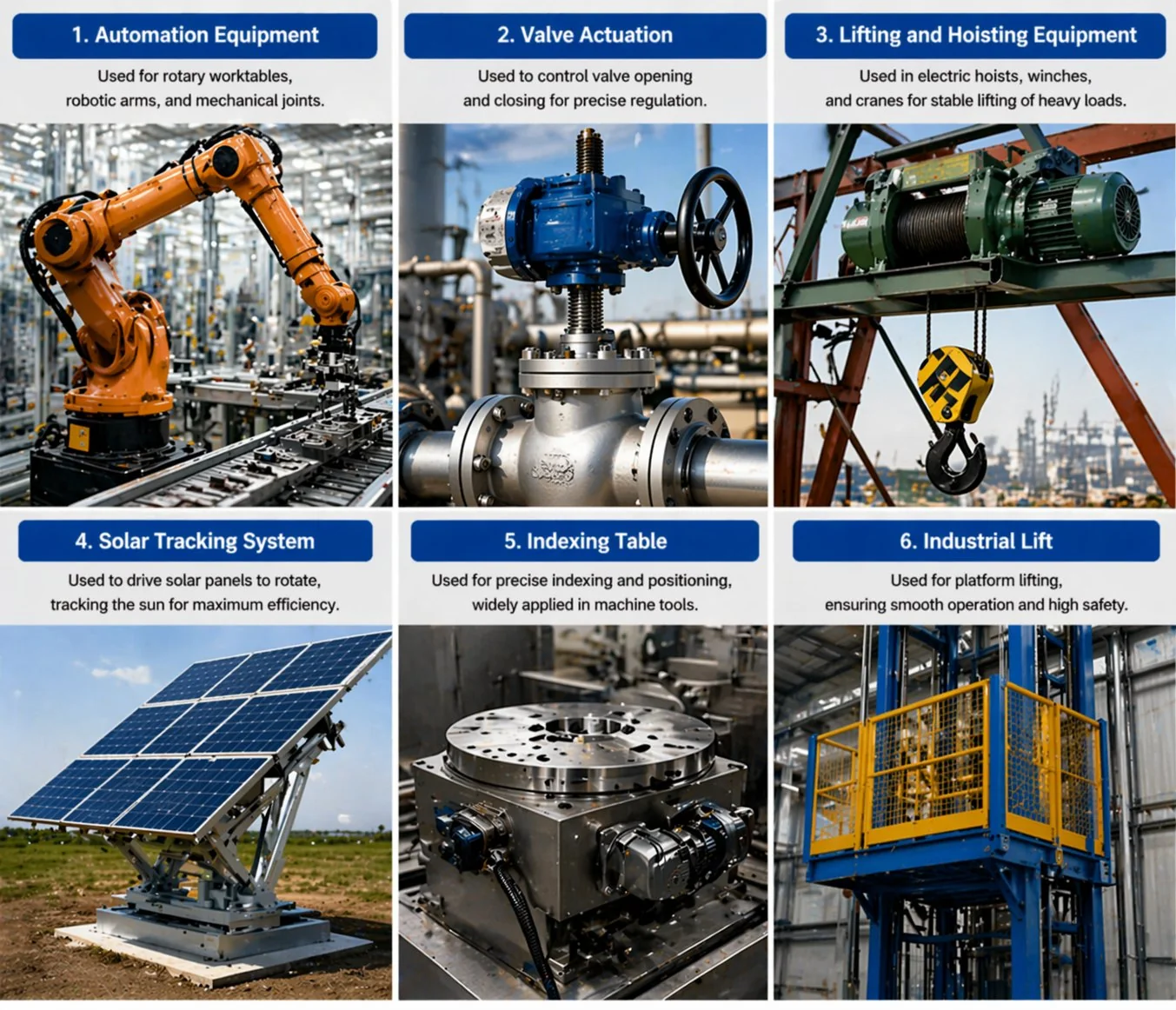
Case 1 — Korean e-commerce warehouse: 500 kg payload shelf-carrier AGV
A Korean fulfilment technology company specified worm gear pairs for a fleet of 120 shelf-carrying AGVs operating in a 15,000 m² warehouse. Payload: 500 kg (loaded shelf unit). Travel speed: 1.0 m/s. Drive wheels: 150 mm diameter, two driven plus two castors. Motor: 200 W BLDC, 3,000 RPM. Required output torque: 80 N·m. Ratio: 20:1. Worm gear pair: single-start, module 1.5, centre distance 35 mm, MC Nylon wheel. Efficiency: 52 percent. Self-braking: yes (γ = 3.8 degrees, lead angle below friction angle with dry nylon-on-steel contact). Noise: 48 dB(A) at 1 m. Battery: 48 V / 10 Ah. Range per charge: 8 km. Mission per charge: 1.2 km. Cost per gear pair: 28 USD. Fleet hardware saving versus planetary: 12,000 USD (gear + eliminated brakes). Service life: MC Nylon wheel replaced every 14 months (4,200 operating hours). Replacement cost per wheel: 4.50 USD. Replacement time: 12 minutes per unit.
Case 2 — Japanese hospital delivery robot: 30 kg payload, ultra-quiet, long range
A Japanese medical robotics company evaluated worm gear pairs for a hospital delivery robot carrying medication trays and laboratory samples across a 400-bed hospital. Payload: 30 kg. Travel speed: 0.8 m/s. Noise limit: 45 dB(A) at 1 m (patient corridor nighttime). Range requirement: 12 km per charge (multi-floor delivery with elevator transitions, 8-hour shift). Motor: 100 W BLDC. Required output torque: 25 N·m. Worm gear pair candidate: module 1, centre distance 25 mm, MC Nylon wheel, efficiency 48 percent. Noise test: 44 dB(A) — passed. Range test: 48 percent efficiency gave 7.2 km range with the 720 Wh battery pack — failed the 12 km requirement. A planetary gearbox at 91 percent efficiency would deliver 13.5 km range — passed. The hospital robot manufacturer chose planetary for the production design despite the 95 USD per unit cost increase, because the mission range could not be compromised and increasing battery size would exceed the weight limit for elevator loading. Lesson: when range is the binding constraint, worm gear efficiency cannot be compensated by a larger battery if weight or space limits exist. Browse compact worm gear reducer options for AGV applications where short mission range allows the efficiency trade-off.
Case 3 — Vietnamese garment factory: 200 kg fabric roll carrier, cost-driven
A Vietnamese garment factory automation integrator specified worm gear pairs for 24 fabric roll carrier AGVs operating on a flat factory floor between cutting stations and sewing lines. Payload: 200 kg (fabric roll). Travel speed: 0.6 m/s (pedestrian-safe zone). Motor: 150 W BLDC. Required output torque: 45 N·m. Ratio: 15:1. Worm gear pair: 2-start, module 1.5, centre distance 30 mm, POM wheel. The 2-start specification was chosen because the factory floor was completely flat (no ramp), eliminating the self-braking requirement — and the 2-start pair at 68 percent efficiency extended battery range by 30 percent versus the single-start at 48 percent. The trade-off: no self-braking means the AGV motor controller must hold position electronically when stopped, and the software must detect motor power loss and engage a solenoid pin brake within 200 ms. Noise: 50 dB(A) at 1 m — acceptable for factory environment. Cost per pair: 18 USD at 500-unit annual volume. Total fleet gear cost: 24 × 18 = 432 USD versus approximately 2,880 USD for planetary (24 × 120 USD). Fleet saving: 2,448 USD — meaningful for a cost-competitive Vietnamese manufacturing operation. Lesson: when the floor is flat and self-braking is not required, 2-start or 3-start worm gear pairs deliver significantly better efficiency while retaining the compact 90-degree layout advantage.
Často kladené otázky
Q: Can I use a 2-start worm gear pair on an AGV that encounters ramps?
A 2-start pair at typical q values has a lead angle of 10 to 12 degrees — well above the friction angle for steel-on-nylon or steel-on-bronze contact. The pair will not self-brake, and the AGV will roll backward on any slope unless the motor controller actively holds position or a separate brake is fitted. If the ramp gradient exceeds 3 degrees and the AGV must park on the ramp (even briefly during traffic management), a single-start self-braking pair or a separate brake is required. If ramps are only for transit (the AGV never stops on the ramp), a 2-start pair with active motor hold is acceptable — but verify that the motor controller response time is fast enough to prevent perceptible backward roll during a communication timeout or software fault.
Q: How long does a plastic worm wheel last in an AGV application?
Typical service life for MC Nylon or POM worm wheels in AGV duty is 3,000 to 8,000 operating hours, depending on load, speed, lubrication (greased or dry-running), and ambient temperature. At 3,000 hours per year (single-shift warehouse AGV), expect 1 to 2.5 years per wheel. At 6,000 hours per year (multi-shift fulfilment centre), expect 6 to 16 months. The replacement indicator is backlash growth — when output shaft play exceeds the positioning tolerance of the AGV navigation system (typically 1 to 3 mm at the wheel contact point), replace the wheel. Replacement on a modular AGV drive takes 10 to 15 minutes with basic tools.
Q: Is the worm gear pair the bottleneck for AGV maximum speed?
Rarely. Most AGVs travel at 0.5 to 2.0 m/s (safety-limited for pedestrian zones). At 1.5 m/s with 150 mm wheels and 20:1 ratio, the worm input speed is approximately 3,800 RPM — within typical BLDC motor range and below the worm gear pair speed limit. The speed bottleneck for worm gears is typically above 4,500 RPM input, which corresponds to AGV travel speeds above 2.5 m/s at common wheel and ratio combinations. Since most AGV safety standards limit travel speed to 1.5 to 2.0 m/s in shared human-robot environments, the worm gear pair input speed stays comfortably within limits. For outdoor AMRs operating at higher speeds (up to 5 m/s), verify the input RPM against the pair speed rating before committing.
Q: Does the worm gear heat generation affect AGV battery temperature?
At the power levels typical for AGVs (100 to 500 W motor), the worm gear heat generation is modest in absolute terms: a 200 W motor at 52 percent worm efficiency produces approximately 96 W of heat at the gear pair. This heat is dissipated through the aluminium housing and the wheel mount structure. Battery compartment temperature is rarely affected because the gear unit is located at the wheel, physically separated from the battery pack in the chassis centre. For larger AMRs (1 kW+ motors) with enclosed chassis, verify that the worm gear housing temperature does not exceed 80 degrees Celsius at continuous rated load — plastic worm wheels begin to soften above 80 degrees and lose dimensional accuracy.
Q: Can a worm gear AGV drive be back-driven for manual pushing during maintenance?
Not if the pair is self-locking (single-start, lead angle below friction angle). The AGV cannot be pushed manually when de-energised — the self-locking worm holds the wheels stationary. This is intentional during normal operation (slope hold) but inconvenient during maintenance or battery-dead recovery. Two solutions: (1) design the drive module with a mechanical release lever that disengages the worm from the wheel, allowing free-wheeling for manual pushing; (2) use a 2-start non-locking pair (requires a separate electronic or mechanical brake for slope holding). Solution (1) is more common because it preserves the self-braking advantage during normal operation while providing manual mobility when needed.
Q: What is the minimum order quantity for custom AGV worm gear pairs?
Standard catalogue worm gear pairs suitable for AGV applications (module 1 to 2, centre distance 25 to 50 mm) are available in single-unit quantities for prototyping. For custom specifications (non-standard ratio, plastic wheel material, integrated motor flange, specific shaft configuration), the typical MOQ is 50 to 100 pairs — achievable for most AGV manufacturers within one production quarter. At 500+ unit annual volume, custom tooling costs are amortised and the per-unit cost reaches the 25 to 45 USD range quoted in the comparison table. Prototype pairs at custom specification typically cost 3 to 5 times the production price per unit and require 3 to 4 weeks lead time.
The worm and worm wheel occupies a specific niche in AGV and AMR wheel drive design: the compact, cost-effective, self-braking gear solution that trades battery range for hardware simplicity. The 9-parameter comparison table makes the trade-off quantitative — the worm pair wins on envelope, self-braking, noise, and cost but loses on efficiency and battery range. The decision boundary is the mission profile: short-range warehouse AGVs (under 2 km per charge) benefit from worm gear cost savings; long-range hospital and campus robots (over 5 km per charge) need planetary efficiency. Plastic worm wheels (MC Nylon, POM) deliver 45 to 50 dB(A) noise performance suitable for hospital and cleanroom environments, at the cost of shorter wheel life (1 to 2.5 years versus 5 to 8 years for bronze). For Korean AGV manufacturers building fleets of 100+ units, the worm gear cost advantage compounds to five-figure fleet savings — but only when the mission profile fits.
For AGV and AMR manufacturers evaluating worm gear wheel drives, our engineering desk runs the efficiency-to-range calculation against your mission profile and recommends the right gear type. Standard catalogue compact worm gear sets cover centre distances from 25 to 63 mm in both bronze and plastic wheel materials with single-start and multi-start configurations. Custom AGV drive modules with integrated motor flanges available at 50+ unit MOQ — submit a AGV drive specification with your motor data and mission profile for a recommendation within one working day.
Evaluating worm gear pairs for an AGV or AMR wheel drive?
Send payload weight, wheel diameter, travel speed, battery capacity, range requirement, noise limit, and whether the vehicle encounters ramps. We will run the efficiency-to-range calculation and recommend worm gear, planetary, or hybrid — whichever fits your mission.
edit by cxm