Korea Ever-Power · Application Engineering Guide
Worm and Worm Wheel for Escalator and Moving Walkway Drives
A Seoul metro escalator runs 18 hours per day, 365 days per year — roughly 6,570 hours annually at full load without a single stop. The worm gear pair inside that drive unit generates 5 to 12 kW of continuous waste heat with no recovery cycle. This is the most thermally demanding application for any worm and worm wheel pair in industrial use, and the thermal budget — not the torque capacity — is almost always the binding design constraint.
Escalators and moving walkways are the most thermally demanding continuous-duty worm gear application. A 15 kW escalator drive with a single-start worm gear pair at 48 percent efficiency generates 7.8 kW of waste heat continuously for 18 hours per day. The housing must dissipate this heat without exceeding 90 degrees Celsius (grease limit) or 100 degrees Celsius (oil bath limit). Escalator worm gear pairs therefore use oil-bath lubrication rather than sealed grease — the oil serves as both lubricant and heat transfer medium. The thermal steady-state temperature is calculated from T_housing = T_ambient + P_heat / (h × A), where h is the convection coefficient and A is the housing surface area. If the calculated temperature exceeds the oil limit, forced-air cooling or an oil cooler must be added. Escalators at standard 30-degree incline and 0.5 m/s step speed use single-start worm gear pairs at ratios of 25:1 to 50:1 with centre distances of 160 to 250 mm. Public-space noise limits (60 to 68 dB(A) at 1 metre per EN 115) require ground worm finish of Ra 0.4 µm or better.
Why escalators are the toughest thermal challenge for worm gear pairs
Most worm gear applications have some form of thermal relief: belt conveyors stop between shifts, crane hoists lift intermittently with rest periods, gate operators cycle a few times per hour. Escalators have none. A metro station escalator starts at 5:30 AM and runs at constant speed until 11:30 PM — 18 hours of continuous full-load operation with zero thermal recovery periods. During peak commute hours (7:00-9:00 AM, 5:00-7:00 PM), the step chain carries maximum passenger weight, and the worm gear pair operates at or near its rated torque for sustained periods.
The thermal challenge is straightforward: a worm gear pair at 48 percent efficiency converts 52 percent of input power to heat. For a 15 kW escalator motor, that is 7.8 kW of continuous heat generation inside the drive unit housing. This heat must be dissipated to the surrounding air through the housing surface — and if the housing cannot dissipate 7.8 kW, the temperature rises until it either reaches equilibrium or exceeds the lubricant limit.
No other common worm gear application generates this much continuous heat at this duty factor. The thermal budget is therefore the primary design constraint for escalator worm gear pairs — not the torque capacity, not the self-locking requirement, not the noise specification.
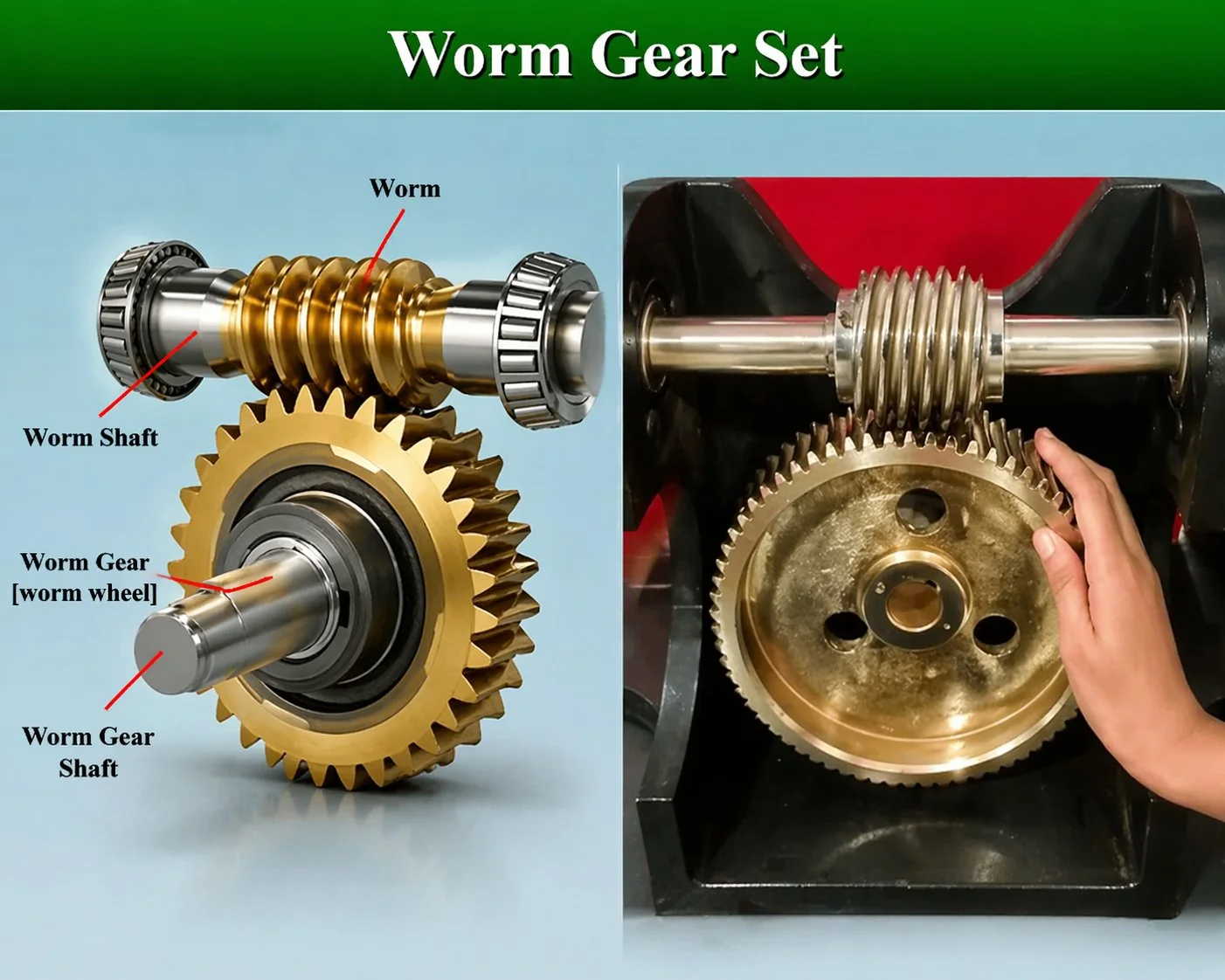
Continuous-duty thermal model — predicting steady-state housing temperature
The thermal model for an escalator worm gear pair calculates the steady-state housing temperature from three variables: heat generated (determined by motor power and gear efficiency), heat dissipated (determined by housing surface area and convection conditions), and ambient temperature (determined by the escalator pit or machine room environment).
The table below applies this model to four escalator sizes at natural and forced convection, showing which configurations need active cooling and which can rely on natural heat dissipation alone.
Table assumptions: housing surface area 0.8 m², natural convection h = 12 W/m²·K, forced convection h = 30 W/m²·K, ambient 30°C (typical escalator pit in summer). All temperatures are steady-state after 4+ hours of continuous operation.
The table reveals a clear split: single-floor retail escalators (7.5 kW) can operate with natural convection alone. Everything above — double-floor retail, metro stations, deep metro — requires forced-air cooling, oil cooling, or both. The deep metro case at 185 degrees Celsius with natural convection is physically impossible (the oil would combust at 250 degrees Celsius) — it simply means the housing cannot dissipate the heat fast enough under any natural condition, and mechanical cooling is mandatory.
Why escalator worm gear pairs use oil-bath rather than sealed grease
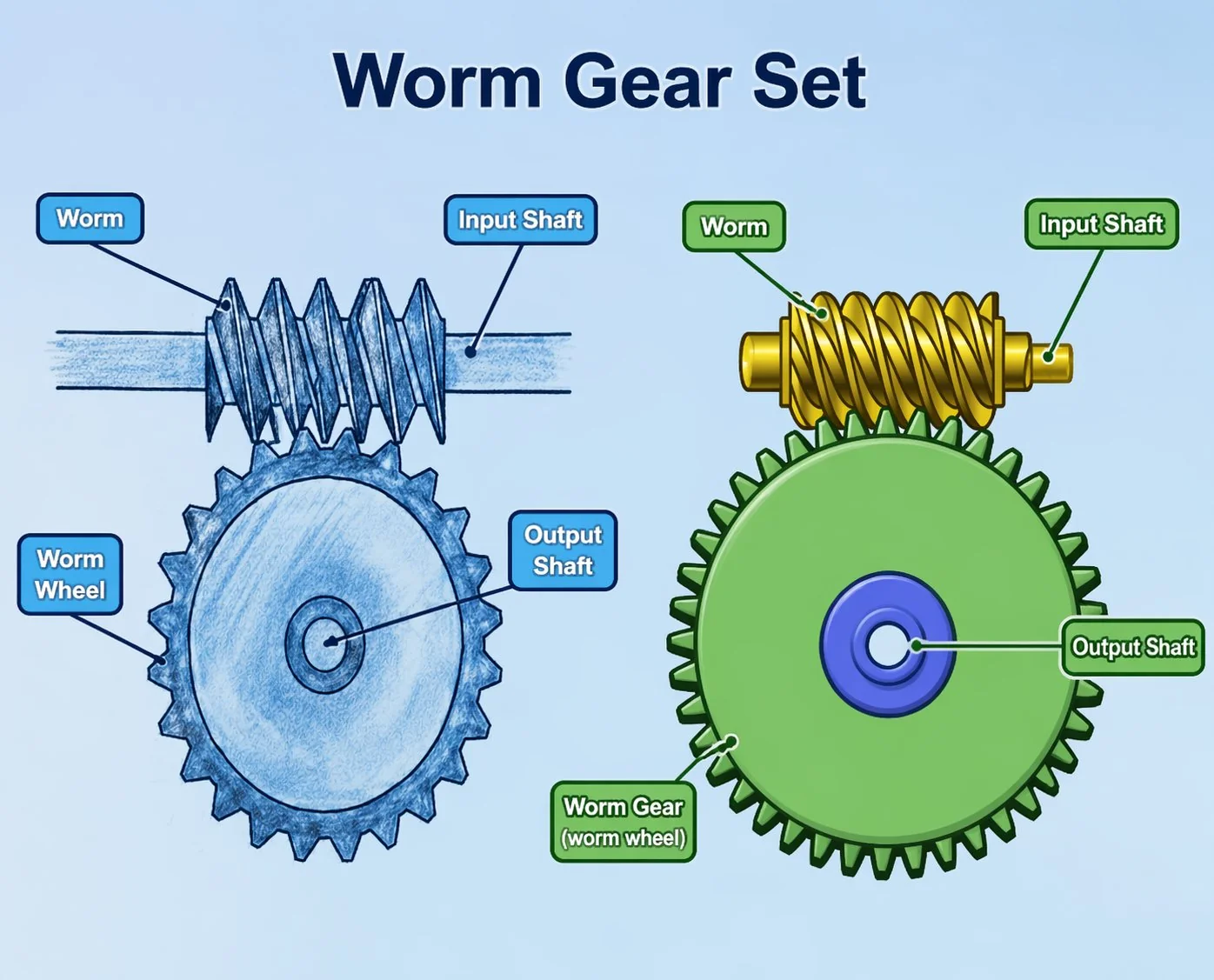
Most industrial worm gear pairs use sealed lifetime grease. Escalators are the exception. The continuous thermal load degrades grease far faster than the nominal grease life rating predicts — at 85 degrees Celsius steady-state, grease life drops to roughly 4,000 to 6,000 hours (the Arrhenius 10-degree halving rule from the factory 70 degrees Celsius reference). At 6,570 hours per year of operation, the grease would be exhausted within 7 to 10 months — requiring annual grease repacking that is impractical on a continuously operating escalator.
Oil-bath lubrication solves both problems simultaneously. The oil provides superior heat transfer compared to grease (liquid convection versus conduction through a semi-solid), which lowers the steady-state temperature by 10 to 20 degrees Celsius at the same heat generation rate. And oil can be monitored, filtered, and changed on a scheduled basis without disassembling the gear housing — typically every 2 to 3 years based on oil analysis (viscosity, acid number, water content).
Oil specification for escalators. ISO VG 320 or VG 460 synthetic PAG (polyalkylene glycol) is the standard. PAG offers lower friction coefficient than mineral oil (improving efficiency by 2 to 5 percentage points), higher thermal stability (operational to 120 degrees Celsius versus 90 degrees Celsius for mineral), and better bronze compatibility than PAO synthetics. Oil volume in a typical escalator worm gear housing: 8 to 25 litres depending on frame size. The oil level sight glass should be checked monthly and topped up if needed — evaporation and seal weep reduce level by 0.5 to 1.5 litres per year under normal conditions.
A Seoul metro station replaced the worm gear pair on a 12-metre rise escalator after 11 years of service — roughly 72,000 operating hours. Post-mortem inspection showed the bronze wheel had lost 0.35 mm of tooth thickness (within the normal wear band for that service life) and the oil had been changed on schedule every 2.5 years. The housing steady-state temperature was recorded at 82 degrees Celsius — within the 100 degrees Celsius oil limit but above the 70 degrees Celsius reference. Applying the Arrhenius model: at 82 degrees Celsius the oil degradation rate is 2^((82-70)/10) = 2.3 times faster than the reference rate. The 2.5-year oil change interval should have been shortened to approximately 13 months at the actual operating temperature. Oil analysis at the last change (shortly before pair replacement) showed acid number 3.2 mgKOH/g — above the 2.0 mgKOH/g condemning limit. The oil had been degraded for roughly the last 8 months of the final interval, accelerating the bronze wear rate during that period. The lesson: oil change intervals for escalator worm gear pairs must be adjusted for the actual operating temperature, not the catalogue reference temperature. A 30-second temperature measurement at the housing during routine maintenance provides the data for this adjustment.
Noise specification for escalators in public spaces
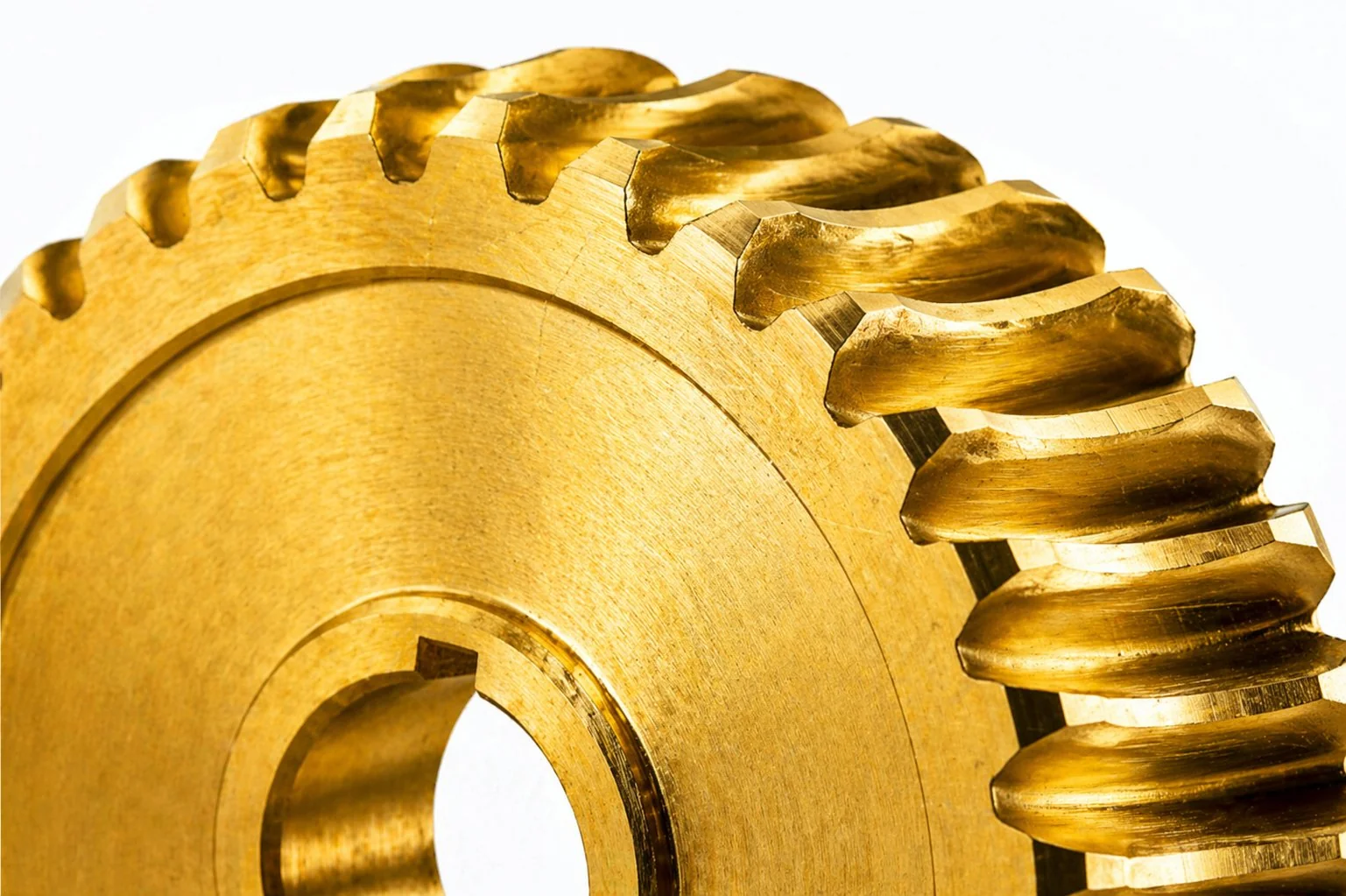
Escalators operate in occupied public spaces — shopping centres, metro stations, airports, hospitals. The worm gear pair noise reaches passengers standing directly above the drive unit at the escalator’s upper or lower landing. EN 115 (escalator safety standard) limits operating noise to 65 dB(A) measured at 1 metre from the drive unit enclosure.
In premium retail environments, building owners often specify tighter limits — 58 to 62 dB(A) — to maintain a quiet shopping atmosphere. These limits directly affect the worm gear surface finish specification.
Surface finish impact on escalator noise. A hobbed worm at Ra 1.6 µm produces 68 to 74 dB(A) at 1 metre — above the EN 115 limit. A ground worm at Ra 0.4 µm produces 58 to 64 dB(A) — within the standard limit and approaching premium retail targets. A lapped worm at Ra 0.2 µm produces 52 to 58 dB(A) — suitable for the most noise-sensitive installations. The ground finish (Ra 0.4 µm) is the standard escalator specification; lapped finish is reserved for premium environments where the additional cost (roughly 40 to 60 percent above ground) is justified by the building grade.
Efficiency benefit of better finish. The surface finish improvement that reduces noise also improves efficiency by 3 to 6 percentage points. A ground pair at 50 percent efficiency versus a hobbed pair at 44 percent efficiency saves approximately 0.9 kW of waste heat on a 15 kW escalator — which feeds back into the thermal model as a lower steady-state temperature. The noise specification and the thermal specification therefore reinforce each other: specifying a better finish to meet noise limits simultaneously reduces the thermal burden on the housing.
Three escalator worm gear pair specification cases
Case 1 — Korean metro station: 10m rise, 22 kW, oil cooler mandatory
Seoul Metro specified worm gear pairs for 8 escalators at a new Line 9 station with 10-metre rise height. Motor: 22 kW, 1,750 RPM. Step speed: 0.5 m/s per EN 115. Ratio: 35:1. Worm gear pair: single-start, module 8, centre distance 200 mm, q = 10, lead angle 4.0 degrees. Oil-bath lubrication with ISO VG 460 PAG synthetic. Efficiency at rated load: 46 percent. P_heat = 22 × 0.54 = 11.9 kW. Thermal model with natural convection only: T_steady = 142 degrees Celsius — far above the 100 degrees Celsius oil limit. Solution: forced-air fan on housing (bringing convection coefficient from 12 to 30 W/m²·K) plus external oil cooler (removing an additional 4 kW). Revised T_steady with cooling: 76 degrees Celsius — within safe margin. Noise: 62 dB(A) at 1 metre with Ra 0.4 µm ground worm — within EN 115 limit. Oil change interval adjusted for 76 degrees Celsius: every 20 months. Bronze wheel service life at metro duty: 10 to 12 years (65,000 to 78,000 operating hours). Cost per worm gear pair: 3,200 USD. Oil cooler system: 1,800 USD per escalator. Total drive specification cost including cooling: 5,000 USD per unit across 8 escalators.
Case 2 — Japanese department store: 6m rise, premium noise specification
A Japanese department store chain specified worm gear pairs for 12 escalators across a new 6-floor Osaka location. Rise per escalator: 4 to 6 metres. Motor: 11 to 15 kW. The specification priority was noise — the store’s “quiet luxury” brand identity required escalator noise below 58 dB(A) at 1 metre, well below the EN 115 standard of 65 dB(A). Worm gear pair: single-start, module 6, centre distance 160 mm, lapped to Ra 0.2 µm. Oil-bath with PAG VG 320 (lower viscosity for lower churning noise). Efficiency at Ra 0.2 µm: 52 percent (roughly 4 points above the same pair at Ra 0.8 µm). P_heat = 15 × 0.48 = 7.2 kW. T_steady with forced-air fan: 68 degrees Celsius — comfortable margin below 100 degrees Celsius. Measured noise: 54 dB(A) at 1 metre — well within the 58 dB(A) target. The lapped finish cost premium: 2,200 USD per pair above ground specification. Across 12 escalators: 26,400 USD total premium. The store operator accepted the cost because the noise reduction contributed measurably to the in-store ambience that differentiated the brand. Browse worm gear speed reducer for escalator options that include lapped and ground surface finish for public-space noise compliance.
Case 3 — Vietnamese airport moving walkway: horizontal, 60m length, thermal challenge
A Vietnamese international airport specified worm gear pairs for four 60-metre horizontal moving walkways connecting terminal buildings. Moving walkways at 0 degrees incline have no gravitational load — the torque demand is entirely from passenger weight friction and pallet chain resistance. However, the 60-metre length means a long pallet chain with significant rolling resistance, and the drive unit must overcome startup friction across the full chain length. Motor: 18.5 kW. Ratio: 30:1. Worm gear pair: 2-start (no anti-rollback needed on horizontal), module 6, centre distance 160 mm. The 2-start specification increased efficiency to 68 percent — a significant thermal advantage over a single-start at 48 percent. P_heat = 18.5 × 0.32 = 5.9 kW versus 9.6 kW for single-start. T_steady with forced fan: 62 degrees Celsius — well within oil limit. The 2-start choice was possible only because the walkway is horizontal — the same walkway on an incline would need single-start for anti-rollback. Noise: 60 dB(A) at 1 metre with ground Ra 0.4 µm — within the airport terminal limit of 65 dB(A). Service life target at airport duty (20 hours per day, 365 days): 8 years per wheel.

자주 묻는 질문
Q: Can an escalator worm gear pair use sealed grease instead of oil-bath?
Only for the lightest-duty single-floor escalators (7.5 kW or below) where the steady-state temperature with natural convection stays below 75 degrees Celsius. At this temperature, high-quality synthetic grease can last 12 to 18 months between repacking — marginal but achievable with annual maintenance. For any escalator above 10 kW or operating more than 12 hours per day, oil-bath lubrication is standard practice. The thermal advantages of oil (better heat transfer, longer change intervals, non-contact temperature monitoring via oil analysis) make it the dominant choice for all but the smallest escalator installations.
Q: What is the typical service life of an escalator worm gear pair?
For a properly specified pair with correct oil change intervals: the bronze wheel typically lasts 8 to 14 years (50,000 to 90,000 operating hours) depending on load profile and thermal management. The steel worm typically lasts 15 to 25 years — the full escalator service life. Metro station escalators with peak-hour near-capacity loading reach the lower end; retail escalators with lighter average loading reach the upper end. Annual backlash measurement tracks wheel wear: plan replacement when backlash reaches 1.5 times the commissioning value. The commissioning backlash value should be recorded and kept in the escalator maintenance file for the life of the machine.
Q: Do escalators need self-locking worm gear pairs?
EN 115 requires escalators to have an operational brake that stops and holds the step band when power is removed. Self-locking worm gear pairs provide an additional holding mechanism beyond the required brake, but EN 115 does not mandate self-locking as a separate requirement (unlike elevator codes that mandate it explicitly). In practice, most escalator worm gear pairs are single-start and self-locking by default at lead angles of 3 to 5 degrees — which provides a valuable redundant holding layer. Horizontal moving walkways can use 2-start or 3-start non-locking pairs because there is no gravitational component to hold against, and the brake alone satisfies the stopping requirement.
Q: How does ambient temperature in summer affect escalator worm gear thermal management?
The ambient temperature in the escalator pit or machine room directly offsets the thermal budget. A pit at 30 degrees Celsius in winter versus 42 degrees Celsius in Korean summer shifts the steady-state housing temperature by the same 12 degrees. An escalator that operates at 78 degrees Celsius housing temperature in winter may reach 90 degrees Celsius in summer — approaching the oil limit. Korean and Japanese escalator maintenance programmes should record housing temperature at least twice per year: once in winter (baseline) and once in the hottest week of summer (worst case). If the summer reading approaches 90 degrees Celsius, add forced ventilation to the pit before the next summer arrives. The cost of a ventilation fan (typically 500 to 1,500 USD) is trivial compared to the cost of oil degradation and accelerated worm gear wear from sustained over-temperature operation.
Q: Are VVVF-controlled escalators easier on the worm gear pair than fixed-speed?
VVVF (variable voltage variable frequency) escalator controllers can reduce step speed when no passengers are present — typically from 0.5 m/s to 0.2 m/s or even full stop with auto-restart on passenger detection. This intermittent operation significantly reduces the thermal burden on the worm gear pair because the heat generation during slow-speed or standby periods is 10 to 30 percent of full-speed heat generation. A VVVF-controlled escalator that runs at full speed only 40 percent of the operating day generates roughly 40 to 60 percent less cumulative heat than a fixed-speed unit running continuously. The thermal model should be recalculated using the weighted-average heat generation over the daily cycle rather than the full-speed continuous value. Many escalators originally specified with oil coolers for fixed-speed operation can eliminate the cooler when retrofitted with VVVF control — a maintenance simplification worth evaluating.
Escalators and moving walkways impose the most severe continuous thermal duty on any worm gear pair application. The thermal model — P_heat = P_motor × (1 − η), dissipated through T_steady = T_ambient + P_heat / (h × A) — determines whether natural convection suffices (single-floor retail) or active cooling is mandatory (metro stations, deep underground). Oil-bath lubrication replaces sealed grease because the continuous heat generation exhausts grease within months at operating temperature. Surface finish serves dual purpose: reducing public-space noise to EN 115 limits and simultaneously improving efficiency to lower the thermal burden. Horizontal moving walkways uniquely benefit from 2-start or 3-start worm gear pairs for higher efficiency, since anti-rollback is unnecessary on level installations. For Korean metro, retail, and airport operators, the thermal model provides the foundation for cooling system specification, oil change scheduling, and service life prediction — the three maintenance planning pillars for every escalator worm gear drive.
For escalator manufacturers and building maintenance teams, our engineering desk runs the thermal model against your escalator parameters and recommends the cooling configuration. Standard catalogue precision worm gear sets cover escalator sizes from 160 to 250 mm centre distance with ground or lapped finish and oil-bath housing. Submit a escalator drive thermal specification with motor power, rise height, operating hours, and pit ambient temperature.
Specifying a worm gear pair for an escalator or moving walkway?
Send motor power, rise height, step speed, operating hours per day, pit temperature, and noise requirement. We will run the thermal model, recommend cooling configuration, calculate oil change interval, and specify the correct surface finish.
edit by cxm