Korea Ever-Power · Application Engineering Guide
用于滚筒输送机和分拣系统的蜗杆和蜗轮
An e-commerce fulfilment centre running 40,000 parcels per hour uses hundreds of individually controlled roller zones — each powered by a compact worm gear pair that starts and stops 300 times per hour, 20 hours per day. The worm gear pair is not just a speed reducer here; it is the building block of the entire zero-pressure accumulation architecture.
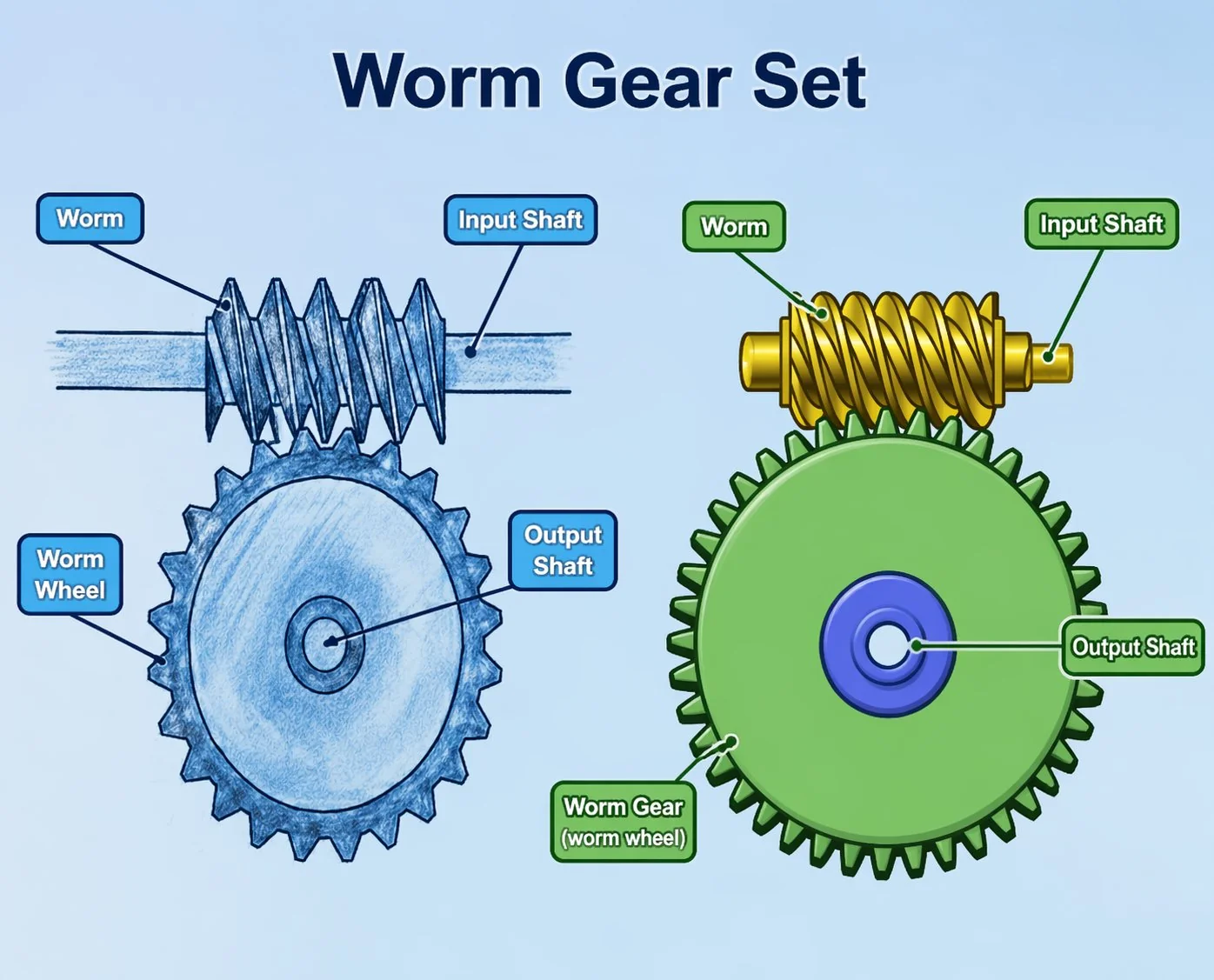
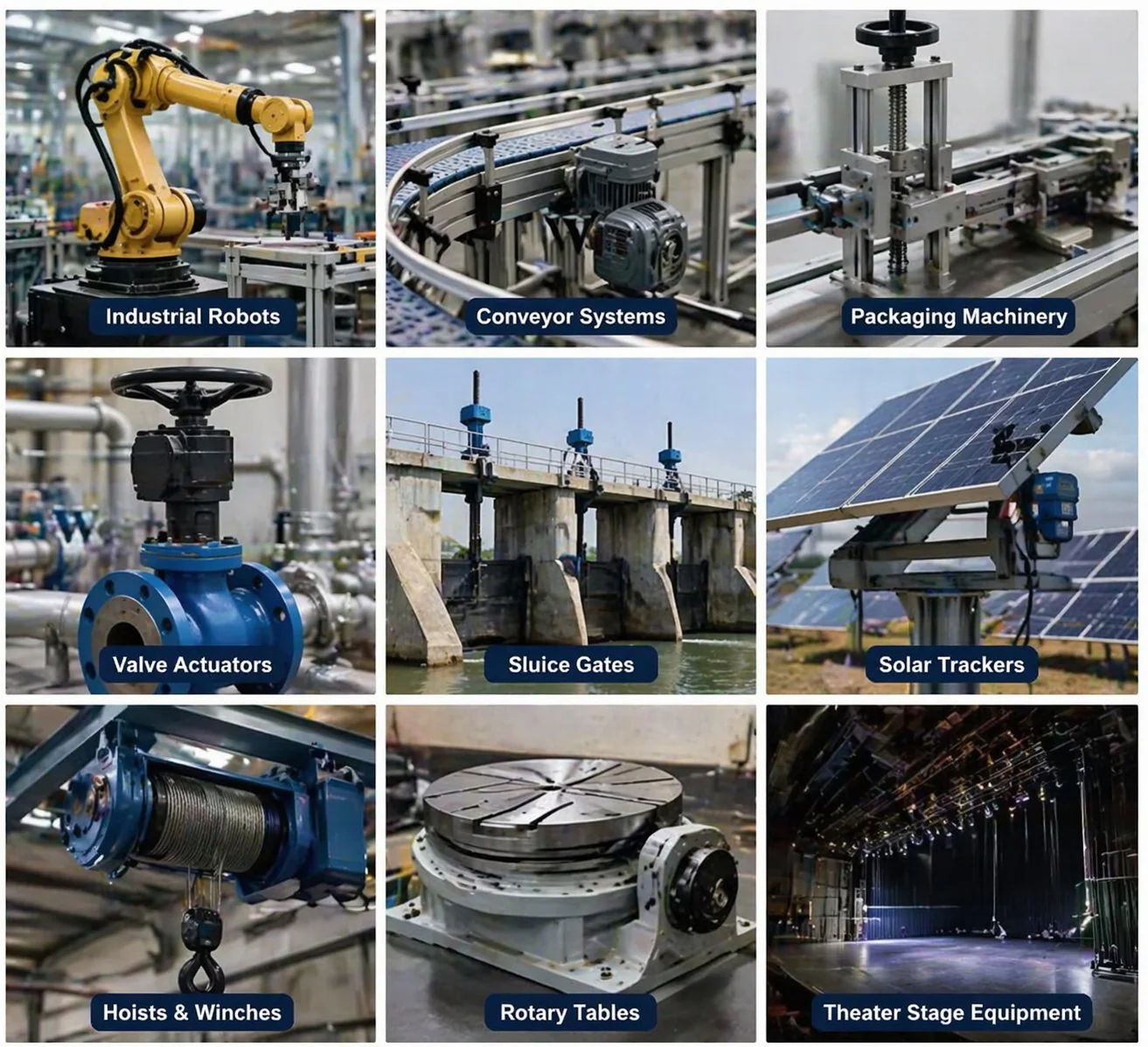
Powered roller conveyors and sortation lines use a zone-drive architecture where one compact worm gear pair drives 3 to 8 rollers in a zone through O-ring bands or timing belts. Each zone starts and stops independently — zero-pressure accumulation (ZPA) — creating a start-stop cycle count of 200 to 500 per hour per zone. This high-cycle intermittent duty is fundamentally different from continuous belt conveyor operation and stresses the worm gear pair differently: thermal fatigue from repeated cold-start-to-hot-run transitions, lubricant shearing from frequent acceleration, and coupling wear from start torque spikes. Horizontal roller conveyors do not need self-locking, so 2-start or 3-start worm gear pairs at 65 to 85 percent efficiency are standard — saving significant energy over single-start pairs. Compact size is essential: the worm gear pair must fit within or beneath the conveyor frame profile, typically requiring centre distances of 25 to 50 mm. Plastic worm wheels (POM or MC Nylon) are increasingly used for noise reduction in fulfilment centres operating near residential areas during night shifts.
Why sortation lines use distributed worm gear drives
A belt conveyor uses one large motor and one large gear pair to drive the entire belt. A powered roller conveyor uses the opposite approach: many small motors and many small gear pairs, each driving a short zone of 3 to 8 rollers independently. This distributed architecture is the foundation of modern e-commerce fulfilment, parcel sorting, and baggage handling — because it allows each zone to start, stop, and change speed independently of its neighbours.
Each zone has a sensor (photoelectric or proximity) that detects whether a parcel is present. When the downstream zone is occupied, the current zone stops — preventing parcels from colliding. This requires each zone to have its own controllable drive — one worm gear pair per zone.
The worm gear pair mounts between rollers inside or beneath the conveyor frame. The motor sits perpendicular to the roller axis. Total package height: 60 to 90 mm — fitting within a standard 100 mm frame height. No gear type other than the worm pair achieves this compactness at the required ratio.
The worm gear pair output shaft carries a drive roller. Adjacent rollers are linked by O-ring bands or round-section timing belts that slip over the roller ends. One worm gear pair thus powers an entire zone through simple elastomeric coupling — no chains, no sprockets, no lubrication on the distribution side.
Zone-drive architecture — how one worm gear pair powers a roller zone
The diagram below shows the layout of a typical 5-roller zone. The worm gear pair sits at the centre of the zone, driving the centre roller directly. Adjacent rollers are linked to the driven roller by elastomeric O-ring bands. The entire zone acts as a single transport unit — all 5 rollers start and stop together when the zone controller commands.
Understanding this architecture is essential for worm gear pair specification because the gear pair must handle the startup torque of all rollers in the zone simultaneously, not just one roller.
  Zone sensor (photo-eye)
        |
  [R1]--O--[R2]--O--[R3 DRIVEN]--O--[R4]--O--[R5]
                      |
                 [WORM GEAR PAIR]
                      |
                 [BLDC MOTOR 24V/48V]
                      |
                 [Zone controller]

  O = O-ring band or round timing belt
  R1-R5 = Ø50 steel rollers, 400-600mm face width
  Zone length: 400-800mm (matches largest parcel dimension)
  Zone controller: 24V DC, start/stop + speed via PWM or RS485
Torque calculation for zone startup. Each roller has rotational inertia J_roller (typically 0.0002 to 0.0008 kg·m² for Ø50 steel, 400 mm wide). A 5-roller zone with O-ring transmission has total reflected inertia at the driven roller of approximately 5 × J_roller × 1.15 (O-ring slip factor). At a startup time of 0.3 seconds to reach 0.5 m/s roller speed, the acceleration torque is T_acc = J_total × (ω / t_start). Combined with the friction torque of the parcel load (typically 3 to 8 N·m for a 30 kg parcel on 5 rollers), the total startup torque reaches 8 to 15 N·m at the driven roller — which the worm gear pair must deliver from the motor side after accounting for gear ratio and efficiency.
Rollers per zone. The number of rollers per zone is determined by the largest parcel the system handles. A zone must be long enough that one parcel occupies no more than one zone (otherwise the zone sensor logic breaks). For Korean e-commerce (maximum parcel 600 mm long), a 5-roller zone at 130 mm pitch gives 650 mm zone length. For European airport baggage (maximum bag 900 mm), 7 to 8 rollers per zone are common. More rollers per zone means higher startup torque demand on the worm gear pair.
Start-stop cycle life — the wear pattern unique to sortation drives
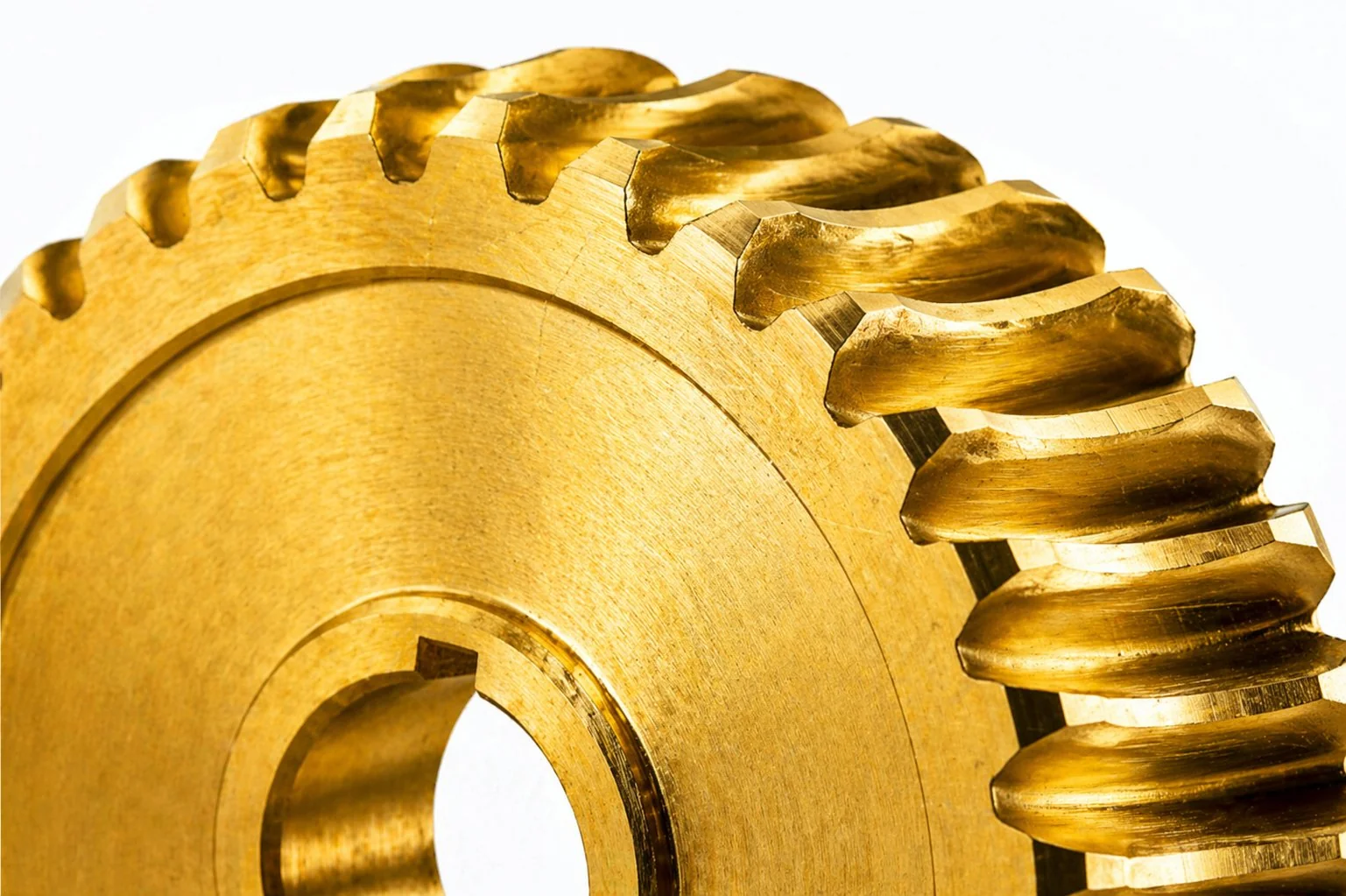
A continuous belt conveyor worm gear pair runs at steady state for hours. A sortation zone worm gear pair starts and stops 200 to 500 times per hour — roughly every 7 to 18 seconds. Over a 20-hour operating day, that is 4,000 to 10,000 start-stop cycles per day, or 1.2 to 3.0 million cycles per year. This high-cycle intermittent duty produces three wear mechanisms that continuous-duty pairs rarely encounter.
The worm gear pair service life in sortation duty is therefore measured in start-stop cycles rather than operating hours. A pair rated for 20,000 hours continuous duty may last only 12,000 to 15,000 hours in sortation duty because the cumulative startup spike damage exceeds what the hour count alone would predict. Specifying the worm gear pair from a continuous-duty catalogue without applying a sortation service factor (SF 1.5 minimum, SF 2.0 for high-speed sorters above 2.5 m/s) leads to premature pitting failures at 12 to 18 months — frustrating because the pair “should have lasted 3 to 4 years” based on the hour rating alone.
A Korean e-commerce fulfilment centre operating near a residential district in Incheon faced noise complaints from night-shift operations. The sortation system used 340 zone drives, each with a standard case-hardened steel worm and phosphor bronze wheel at module 1.5, centre distance 35 mm, 2-start, ratio 15:1. Measured noise per zone drive: 58 dB(A) at 1 metre. Cumulative noise at the building boundary (15 metres from the nearest sortation line): 72 dB(A) — exceeding the Korean Night Noise Standard of 55 dB(A) at the residential boundary. The facility installed sound insulation panels around the sortation area at a cost of 42,000 USD. The alternative — replacing the 340 bronze worm wheels with POM (acetal) wheels — would have reduced per-zone noise to approximately 47 dB(A), bringing the boundary measurement below 60 dB(A) and potentially eliminating the need for insulation panels entirely. Wheel replacement cost: 340 × 12 USD (POM wheel) = 4,080 USD. The insulation panels cost 10 times more than the material change would have. The lesson for any fulfilment centre specified near residential areas: evaluate the worm wheel material for noise performance at the design stage, not after the complaints arrive.
Noise management — worm wheel material choice for fulfilment centres
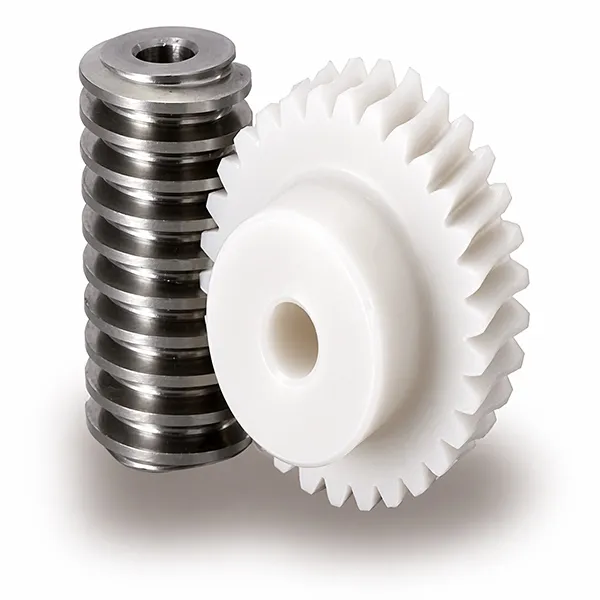
When a sortation line has 200 to 500 zone drives operating simultaneously, even modest per-zone noise compounds into significant cumulative levels. The worm wheel material is the single most effective lever for reducing zone drive noise — changing from bronze to POM reduces per-zone noise by 8 to 12 dB(A), which translates to a perceptible reduction at the building boundary.
Korean night-noise regulations limit boundary noise to 55 dB(A) in residential-adjacent zones. Japanese regulations are similar at 50 to 55 dB(A). Meeting these limits with bronze worm wheels often requires expensive sound insulation; meeting them with POM wheels is often possible without any insulation.
Noise: 55-62 dB(A) per zone at 1 m.
Life: 15,000-25,000 h (continuous) / 10,000-18,000 h (sortation).
Cost: 15-25 USD per wheel.
Best for: Industrial sortation where noise is not regulated, high-load zones (>15 kg parcels), food-grade requirements.
Noise: 45-50 dB(A) per zone at 1 m.
Life: 4,000-8,000 h (sortation duty).
Cost: 4-10 USD per wheel.
Best for: Fulfilment centres near residential areas, night-shift operations, airport baggage, hospital logistics. Replace every 6-12 months in high-cycle sortation.
Three roller conveyor and sortation worm gear pair cases
Case 1 — Korean e-commerce fulfilment: 340-zone sortation, POM for night noise
A Korean third-party logistics (3PL) company built a 20,000 m² fulfilment centre in Incheon, 200 metres from a residential apartment complex. The sortation system comprised 340 zero-pressure accumulation zones across 4 parallel sortation lines, processing 35,000 parcels per shift. Each zone: 5 rollers at 130 mm pitch, Ø50 mm, 500 mm face width. Parcel weight range: 0.5 to 25 kg. Zone cycle rate: 280 starts per hour average. Worm gear pair specification: 2-start, module 1.5, centre distance 35 mm, ratio 15:1, POM wheel. Motor: 24 V DC BLDC, 90 W. Efficiency at rated load: 68 percent (2-start). Per-zone noise: 47 dB(A) at 1 m. Boundary noise with all 340 zones running simultaneously: 54 dB(A) — just below the 55 dB(A) Korean night standard. POM wheel replacement cycle: every 8 months (approximately 4,500 operating hours at sortation duty). Replacement cost per wheel: 6.50 USD. Annual wheel replacement budget for 340 zones: 340 × 6.50 × 1.5 (some zones replaced twice per year) = 3,315 USD. This figure is less than 8 percent of the 42,000 USD sound insulation alternative — and the POM wheels address the noise at the source rather than the symptom.
Case 2 — Japanese airport baggage handling: 520-zone system, bronze for durability
A Japanese airport authority specified worm gear pairs for a baggage handling system (BHS) with 520 accumulation zones across the departing and arriving belts. Airport baggage systems run 18 to 20 hours per day, 365 days per year — approximately 7,000 operating hours annually. Bag weight range: 5 to 32 kg (heavy checked luggage). Zone cycle rate: 180 starts per hour. The specification prioritised service life over noise (airport terminal background noise is high, and the BHS runs in an enclosed underground area away from passengers). Worm gear pair: 3-start, module 2, centre distance 40 mm, ratio 12:1, phosphor bronze CuSn12Ni wheel. Motor: 48 V BLDC, 150 W. Efficiency: 78 percent (3-start at light average load). Bronze wheel service life at BHS sortation duty: 14 months (approximately 8,200 hours at 180 cycles/hour). Replacement cost per wheel: 18 USD. Annual replacement budget: 520 × 18 × 0.85 (85 percent replaced annually, 15 percent last 2 years) = 7,956 USD. The bronze specification eliminated the risk of POM wheel failure under the 32 kg maximum bag weight — a load that would exceed the POM contact stress limit at the startup torque spike. Browse inline worm gear reducer options designed for high-cycle roller conveyor and sortation applications.
Case 3 — Vietnamese garment export shipping: 80-zone accumulation, cost-driven
A Vietnamese garment export facility specified worm gear pairs for an 80-zone accumulation conveyor feeding a truck loading dock. Carton weight: 3 to 12 kg (garment boxes). Zone cycle rate: 120 starts per hour (moderate throughput). Operating hours: 10 hours per day, 300 days per year (3,000 h/year). Noise: not regulated (industrial zone). The specification was cost-driven — the facility evaluated worm gear zone drives against motorised roller (MDR) integrated drives. The worm gear approach used a single 24 V BLDC motor per zone with a separate worm gear pair, at a total per-zone drive cost of 45 USD (motor 28 USD + worm gear pair 17 USD). The MDR alternative embedded the motor and planetary gear inside the roller itself at 85 USD per zone. Total system cost: worm gear approach 80 × 45 = 3,600 USD; MDR approach 80 × 85 = 6,800 USD. The worm gear approach saved 3,200 USD on the 80-zone system — and the external worm gear pair was field-replaceable in 10 minutes without removing the roller from the frame, while MDR failure required full roller extraction. Annual operating cost was higher due to lower worm gear efficiency (65 percent vs MDR planetary at 88 percent), but at only 3,000 h/year the energy difference was modest: approximately 320 USD per year for the entire 80-zone system. Payback on MDR premium: 10 years — well beyond the 5-year equipment lifecycle.
常见问题解答
Q: How many rollers can one worm gear pair realistically drive in a zone?
Practically 3 to 8 rollers per zone for standard parcel handling (under 30 kg). The limit is set by two factors: the O-ring transmission efficiency drops with each additional roller (roughly 3 to 5 percent loss per O-ring junction), and the startup torque of the zone increases linearly with roller count. An 8-roller zone with 25 kg parcels on every roller at a 0.3-second startup time may exceed the worm gear pair rated torque at small centre distances (25-35 mm). For heavy loads or many rollers per zone, either increase the centre distance to provide more torque capacity or split the zone into two sub-zones with independent drives.
Q: Should I use single-start or multi-start worm gear pairs for roller conveyors?
Multi-start (2 or 3 start) is the standard for horizontal roller conveyors and sortation lines. Since the conveyor is horizontal, there is no gravity rollback risk and self-locking is unnecessary. A 2-start pair at 65 to 72 percent efficiency or a 3-start pair at 75 to 85 percent efficiency saves significant energy compared to a single-start pair at 45 to 55 percent. Over 340 zones running 20 hours per day, the efficiency difference between single-start and 3-start is roughly 15,000 kWh per year — approximately 2,000 USD in electricity at Korean industrial rates. The only exception is inclined roller sections (gravity-fed accumulation lanes) where anti-rollback is needed — those specific zones should use single-start pairs while the remainder of the system uses multi-start.
Q: How does a worm gear zone drive compare to a motorised drive roller (MDR)?
MDR integrates the motor and planetary gear inside the roller tube — a self-contained unit with no external gear pair. Advantages: cleaner appearance, slightly higher efficiency (85-92 percent), no external worm gear housing. Disadvantages: higher per-unit cost (1.5 to 2.5 times a worm gear zone drive), replacement requires extracting the entire roller from the conveyor frame (15 to 30 minutes versus 5 to 10 minutes for external worm gear pair swap), and limited torque capacity at small roller diameters. Worm gear zone drives dominate in cost-sensitive, high-zone-count applications (200+ zones). MDR dominates in premium logistics applications where appearance, efficiency, and minimal maintenance matter more than initial cost. The boundary shifts toward worm gear at higher zone counts because the per-unit cost advantage compounds.
Q: What voltage motor is standard for worm gear zone drives?
24 V DC is the dominant standard for roller conveyor zone drives, primarily for safety reasons — 24 V is classified as Safety Extra Low Voltage (SELV) and does not require conduit, junction boxes, or electrician-grade installation in most jurisdictions. The 24 V infrastructure also simplifies the zone controller design and reduces wiring cost across large-zone-count systems. 48 V DC is used for higher-throughput systems (above 2 m/s) or heavier loads (above 30 kg per parcel) where the motor power requirement exceeds what 24 V can efficiently deliver through small-gauge wiring. The worm gear pair specification is independent of motor voltage — the same gear pair works with any voltage motor as long as the input shaft speed and torque are within the pair rating.
Q: How do I calculate the number of worm gear pairs needed for a sortation system?
One worm gear pair per zone. The number of zones is determined by: total conveyor length divided by zone length (typically 400 to 800 mm per zone), plus divert zones at each sort destination. A 100-metre sortation loop with 600 mm zones is approximately 167 zones on the main loop, plus 5 to 20 divert zones depending on the number of sort destinations. Total: 172 to 187 worm gear pairs. Add 5 to 10 percent spare inventory (9 to 19 pairs). For a system with 4 parallel sortation lines, multiply by 4. Planning the worm gear pair procurement at the system design stage — not at installation — ensures volume pricing and consistent lot quality across the entire system.
Roller conveyor and sortation systems use worm gear pairs as the distributed building block of zone-drive architecture — one compact pair per zone, each starting and stopping independently to enable zero-pressure accumulation. The high-cycle start-stop duty (200 to 500 starts per hour) stresses the gear pair differently from continuous belt conveyor operation, requiring sortation-specific service factors and wear-life calculations measured in cycles rather than hours. The worm wheel material choice — bronze for durability or POM for noise reduction — is often the most impactful single decision in the specification, especially for fulfilment centres operating near residential areas under Korean or Japanese night-noise regulations. Multi-start pairs (2 or 3 start) are standard for horizontal sortation because anti-rollback is unnecessary and the efficiency gain over single-start compounds across hundreds of zones to five-figure annual energy savings.
For sortation system integrators and conveyor manufacturers specifying zone-drive worm gear pairs, our engineering desk runs the zone startup torque calculation and noise impact assessment for your facility layout. Standard catalogue compact worm gear sets ship in both bronze and POM wheel variants at centre distances from 25 to 50 mm with multi-start configurations. Volume pricing at 100+ unit quantities — submit a sortation drive specification with zone count, parcel weight range, and noise requirements.
Specifying worm gear pairs for a roller conveyor or sortation system?
Send the number of zones, rollers per zone, parcel weight range, zone cycle rate, noise requirement, and whether the system includes inclined sections. We will calculate zone startup torque, recommend the right wheel material, and quote at fleet volume.
edit by cxm