Engrenagem sem-fim vs. Helicoidal, Planetária, Cônica — Quando escolher a ideal
Uma estrutura prática para tomada de decisões. Comece pelas necessidades da aplicação, não pelas funções de cada tipo de engrenagem, e a resposta certa surge em cinco minutos.
Escolha esta tecnologia quando precisar de uma redução em ângulo reto de estágio único acima de 20:1 com travamento automático opcional e o ciclo de trabalho for intermitente ou moderado. Escolha a tecnologia helicoidal quando precisar de eixos paralelos e alta eficiência em condições de trabalho pesado contínuo. Escolha a tecnologia planetária quando precisar de uma densidade de torque muito alta por unidade de peso em um layout coaxial. Escolha a tecnologia cônica (cônica helicoidal) quando precisar de redução em ângulo reto contínua para serviço pesado com alta eficiência. Os quatro tipos de engrenagens não são intercambiáveis — cada um é a resposta certa para uma combinação específica de layout do eixo, relação de transmissão, ciclo de trabalho e requisito de eficiência. A maioria dos erros de seleção ocorre ao escolher o tipo de engrenagem errado e depois passar meses lutando contra as consequências.
Decida com base na necessidade, não no tipo de equipamento.
Ao abrir a maioria dos artigos de comparação de engrenagens, você encontrará quatro seções, uma para cada tipo de engrenagem, cada uma listando vantagens e desvantagens em forma de lista com marcadores. O formato é o mesmo em toda a indústria, e o formato é exatamente o inverso. Um engenheiro que projeta uma transmissão não começa com "fale-me sobre engrenagens helicoidais". O engenheiro começa com "Tenho eixos a 90 graus, preciso de uma redução de 60:1, a aplicação funciona 16 horas por dia e o travamento automático seria útil, mas não obrigatório". O tipo certo de engrenagem surge desses quatro fatos em cerca de trinta segundos, se você souber qual fato corresponde a qual família de engrenagens.
Este artigo inverte o formato usual. Começamos com os requisitos da aplicação que orientam a escolha — disposição do eixo, relação de transmissão, ciclo de trabalho, eficiência, travamento automático, precisão, custo — e indicamos qual tipo de engrenagem cada requisito representa. Em seguida, comparamos as quatro famílias em uma única matriz de decisão para que você possa visualizar as vantagens e desvantagens rapidamente. O resultado é uma seleção mais rápida e precisa do que a obtida com o formato de tópicos.
As quatro famílias de engrenagens em resumo
Cada família de engrenagens possui um arranjo geométrico distinto que determina suas capacidades e limitações. Compreender a geometria desde o início torna a aplicação mais adequada óbvia.
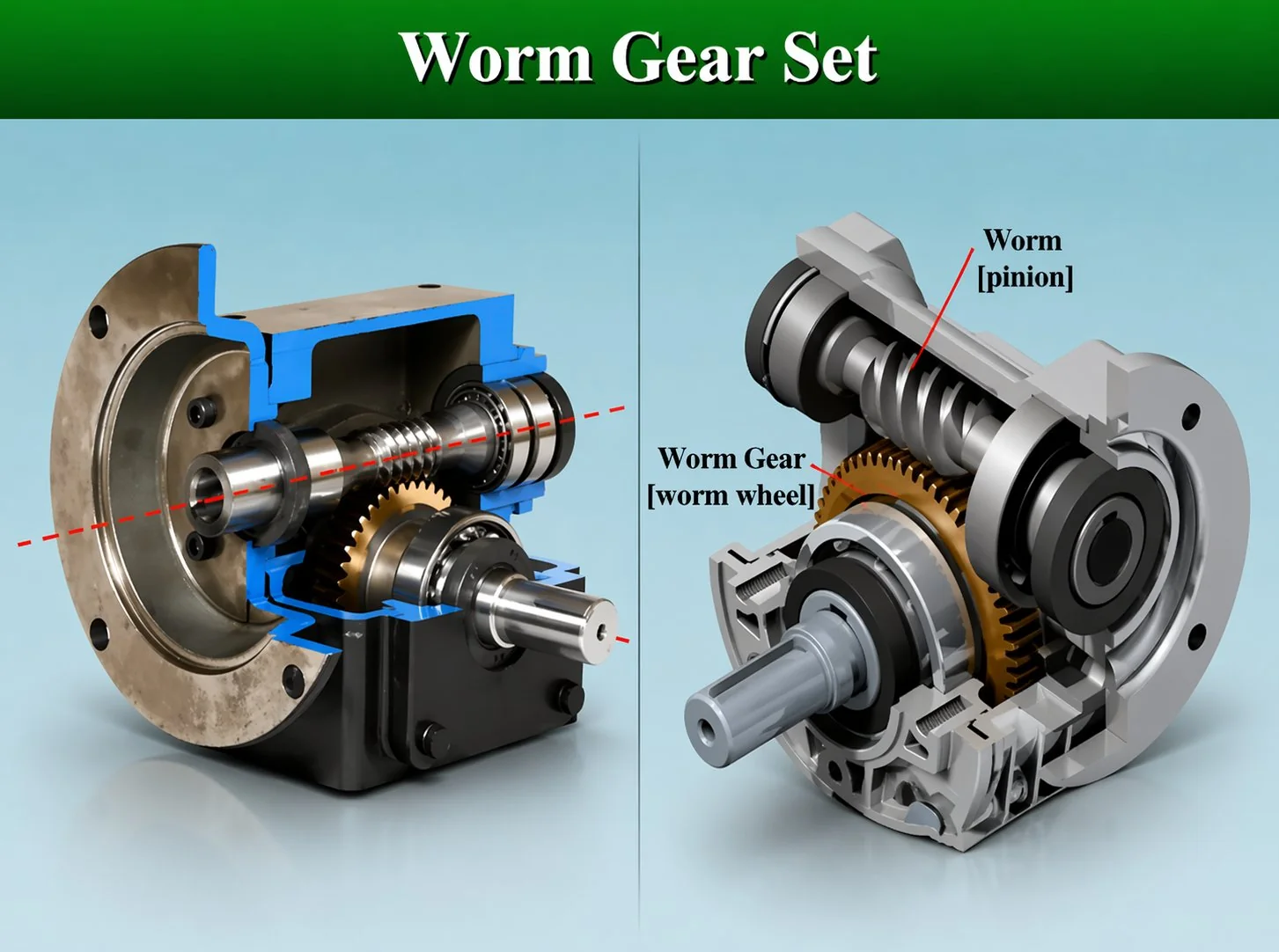
Engrenagem sem-fim: parafuso em um eixo que engata com uma roda em ângulo reto; os eixos não se cruzam. Engrenagem helicoidal: dentes angulados em eixos paralelos. Engrenagem planetária: uma engrenagem solar, várias engrenagens planetárias e uma engrenagem anular que compartilham um eixo comum. Engrenagem cônica: engrenagens cônicas que se encontram em eixos que se cruzam.
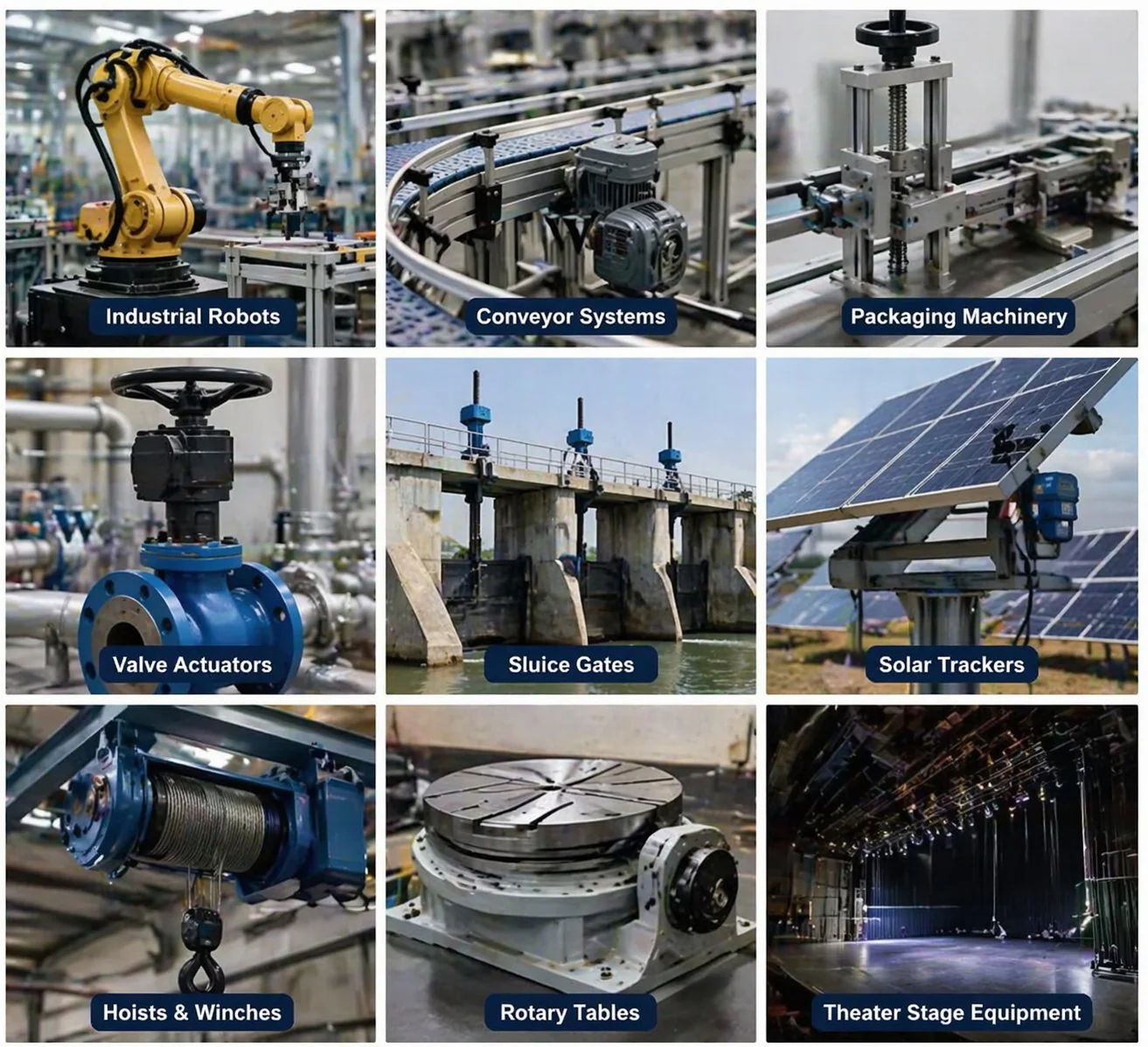
Engrenagem sem-fim — alta relação de transmissão, ângulo reto, serviço intermitente
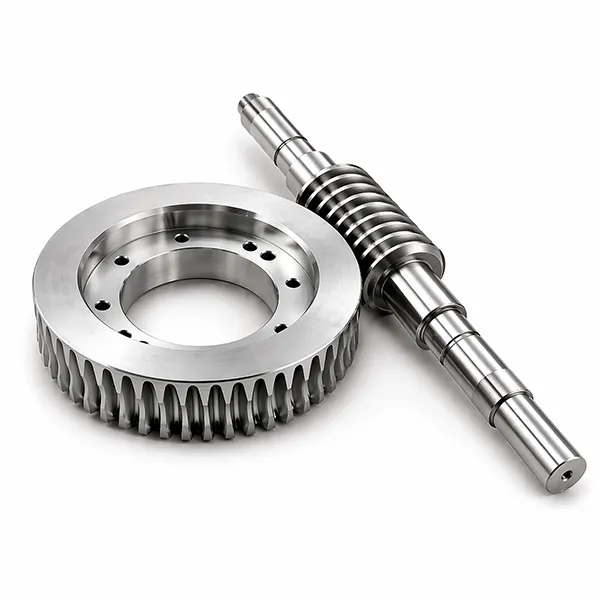
Um conjunto de engrenagem helicoidal e coroa helicoidal proporciona relações de transmissão de 5:1 até 100:1 em um único estágio, com saída em ângulo reto e dimensões reduzidas. A eficiência varia de 60 a 92%, dependendo do ângulo de inclinação. O acionamento pode ser autoblocante quando o ângulo de inclinação é inferior ao ângulo de atrito, o que é útil para guinchos e aplicações de sustentação de carga. As desvantagens são: o contato deslizante gera calor, portanto, o uso contínuo em serviço pesado atinge um limite térmico, e a coroa helicoidal de bronze é uma peça sujeita a desgaste com vida útil limitada por fadiga. É mais indicado para aplicações intermitentes ou de serviço moderado, relações de transmissão de 20:1 ou superiores e quando o layout em ângulo reto é importante.
Engrenagem helicoidal — eixos paralelos, alta eficiência, serviço contínuo
As engrenagens helicoidais utilizam dentes angulados que se engatam gradualmente, em vez de todos de uma vez, produzindo uma transferência de torque suave, silenciosa e eficiente entre eixos paralelos. As relações de estágio único são tipicamente de 1:1 a 6:1; relações mais altas utilizam redutores helicoidais de múltiplos estágios. A eficiência varia de 95% a 98%, pois o contato é predominantemente de rolamento, em vez de deslizamento. As desvantagens são: o layout é limitado a eixos paralelos, o empuxo axial deve ser absorvido por rolamentos e relações de redução muito altas exigem múltiplos estágios, com custos e volume correspondentes. São mais adequadas para aplicações industriais pesadas e contínuas, onde os eixos de entrada e saída são paralelos.
Engrenagem planetária — coaxial, alta densidade de torque, compacta
As engrenagens planetárias dividem a carga de torque entre várias engrenagens planetárias que operam entre uma engrenagem solar e uma engrenagem anular. Três ou quatro planetas compartilham a carga, resultando na maior relação torque/quilograma entre todas as famílias de engrenagens. As relações de estágio único variam de 3:1 a 10:1; conjuntos planetários de múltiplos estágios atingem 1000:1 em um formato compacto. Os eixos de entrada e saída são coaxiais, o que restringe o layout. A eficiência é alta (94 a 98% por estágio). As desvantagens: o custo é maior do que o de engrenagens helicoidais ou sem-fim com classificações de torque equivalentes, e o layout exclusivamente coaxial limita as opções de instalação da caixa de engrenagens. Ideal para posicionamento servo, robótica, transmissões de veículos elétricos e qualquer aplicação onde a densidade de torque e a compacidade sejam fatores determinantes.
Engrenagem cônica — eixos que se cruzam, frequentemente combinados com engrenagens helicoidais.
As engrenagens cônicas transmitem torque entre eixos que se cruzam — tipicamente a 90 graus. As relações de transmissão de estágio único variam de 1:1 a 6:1, semelhantes às engrenagens helicoidais. Em acionamentos industriais, as engrenagens cônicas são geralmente combinadas com engrenagens helicoidais em um redutor "cônico-helicoidal" ou "helicoidal-cônico", onde o par de engrenagens cônicas lida com a mudança em ângulo reto e um ou dois estágios helicoidais cuidam da redução. A unidade combinada oferece eficiência superior a 95% em ângulos retos para relações de até aproximadamente 200:1. As desvantagens são: o custo é maior do que o de engrenagens sem-fim com relação equivalente, a fabricação exige alinhamento preciso e o par de engrenagens cônicas é sensível à precisão de montagem. São mais adequadas para aplicações contínuas de alta potência em ângulo reto, onde os limites térmicos das engrenagens sem-fim forçariam um sobredimensionamento.
Matriz de decisão — associe o requisito à resposta correta.
Cinco linhas da tabela resolvem a maior parte do problema. O layout do eixo elimina imediatamente duas das quatro famílias de engrenagens — se os eixos forem paralelos, as engrenagens planetárias, sem-fim e cônicas estão descartadas. A relação de transmissão em estágio único restringe ainda mais as opções: acima de 20:1, a transmissão sem-fim em estágio único é fortemente indicada; abaixo de 10:1, as engrenagens helicoidais, planetárias ou cônicas-helicoidais são mais indicadas. Para aplicações contínuas de alta potência, a transmissão sem-fim é descartada devido ao limite térmico. A transmissão autotravante exige a transmissão sem-fim. Em termos de custo, a transmissão sem-fim é a mais barata, seguida pela helicoidal, depois pela cônica-helicoidal, sendo a planetária substancialmente mais cara para uma classificação de torque equivalente. A maioria das decisões converge em três ou quatro linhas após a apresentação desses dados.
A linha de custos na matriz surpreende os especificadores iniciantes. A engrenagem helicoidal é a tecnologia de caixa de engrenagens mais barata por quilowatt de potência instalada, frequentemente duas vezes mais barata que a planetária, apesar de ser a opção menos eficiente. A razão é a simplicidade de fabricação — um único par de engrenagem helicoidal e coroa, uma carcaça fundida e rolamentos padrão cobrem todo o custo mecânico. A engrenagem planetária precisa de uma engrenagem solar, três ou quatro planetas, uma engrenagem anular, um porta-satélites, três ou quatro rolamentos por estágio e tolerâncias mais rigorosas em cada um. A diferença de custo se acumula: um redutor helicoidal de 30 kW pode custar metade do preço de um redutor planetário de 30 kW. Para aplicações onde o ciclo de trabalho é moderado e o custo de capital é importante, essa diferença compensa a grande quantidade de eletricidade gerada, mesmo após considerar a perda de eficiência. Faça os cálculos de energia ao longo da vida útil em relação à diferença de custo de capital antes de presumir que a "alta eficiência" vence automaticamente.
Verme versus helicoidal — a comparação direta mais comum
Na maioria das decisões de seleção de acionamentos industriais, a comparação entre engrenagens helicoidais e sem-fim se resume à escolha entre essas duas tecnologias, pois ambas abrangem faixas de potência semelhantes (0,1 a 100 kW) e aplicações industriais similares. A escolha geralmente se baseia em três critérios: configuração do eixo, ciclo de trabalho e relação de transmissão.
Saídas em ângulo reto e relações acima de 20:1 favorecem engrenagens sem-fim. Eixos paralelos e transmissões contínuas de alta potência favorecem engrenagens helicoidais. A maioria dos outros fatores são compensações secundárias que decorrem dessas escolhas primárias.
A desvantagem da engrenagem sem-fim em termos de eficiência elétrica é real, mas frequentemente exagerada. Um redutor sem-fim operando 8 horas por dia com 65% de eficiência consome aproximadamente 50% mais eletricidade do que um redutor helicoidal com 95% de eficiência para a mesma potência de saída. Em uma carga de 5 kW, isso representa 1,7 kW a mais de entrada — cerca de 4.000 kWh por ano, o que equivale a aproximadamente US$ 600 por ano em eletricidade. Se o redutor sem-fim custar US$ 800 a menos do que o redutor helicoidal na compra, o período de retorno do investimento para a opção helicoidal é superior a 12 meses em ciclo de trabalho industrial, e ainda maior em operação intermitente. Para operação contínua de 24 horas, a opção helicoidal se paga em 4 a 6 meses e é a escolha óbvia. Para operação em um único turno de 8 horas, os cálculos são mais precisos do que a maioria dos engenheiros imagina — e o redutor sem-fim às vezes se mostra mais vantajoso em termos de custo total de propriedade, apesar da menor eficiência.
Onde a transmissão sem-fim se destaca: alta relação de transmissão em um único estágio, layout compacto em ângulo reto, travamento automático opcional. Onde a transmissão helicoidal se destaca: alta eficiência sob carga contínua, eixos paralelos, faixa de relação de transmissão mais baixa. Veja a lista completa. redutor de engrenagem helicoidal Opções disponíveis quando esses critérios forem atendidos — relações de estágio único de 5:1 a 100:1 em tamanhos de estrutura padrão para uso industrial geral.
Verme versus planetário — densidade de torque versus custo
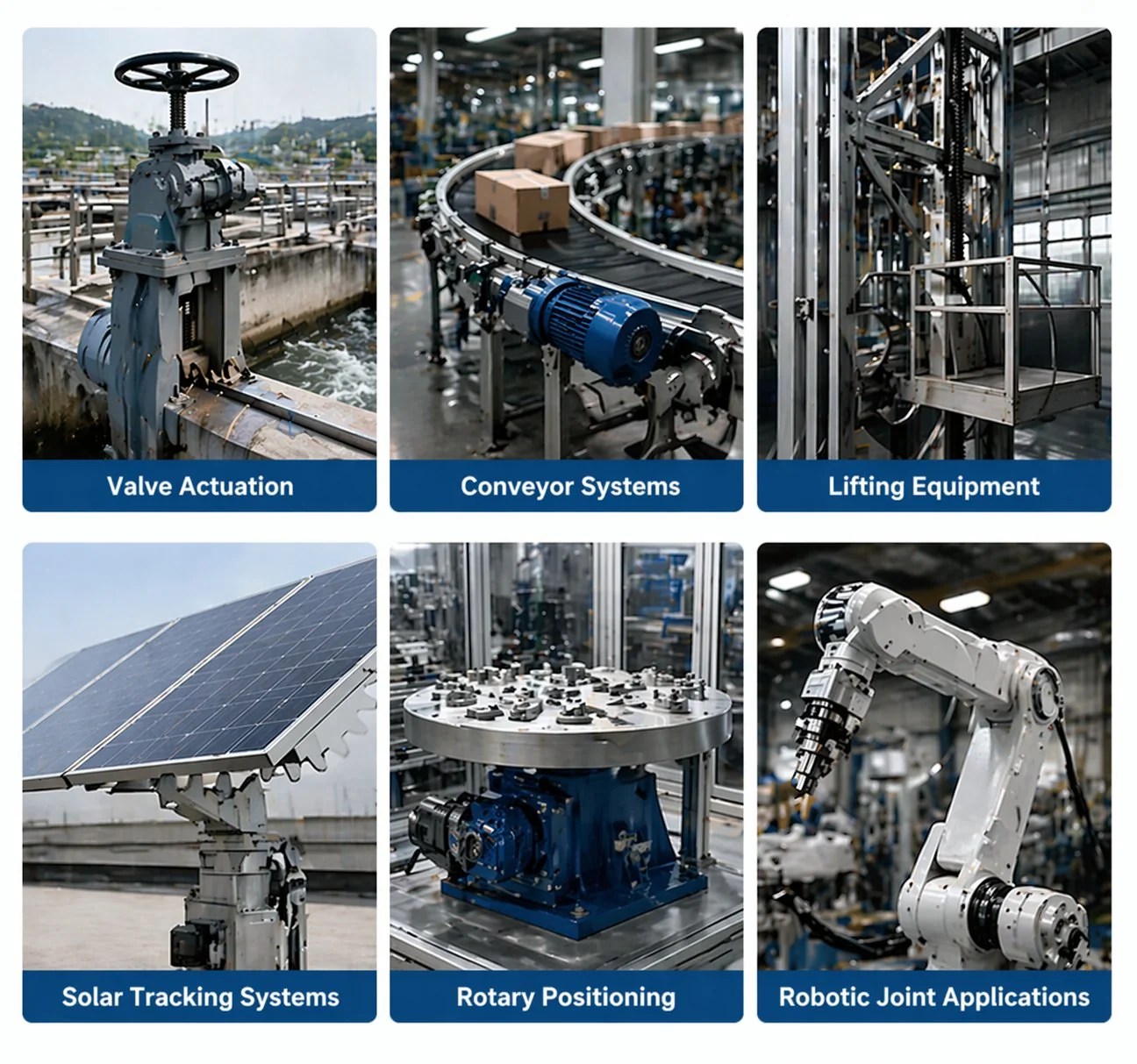
Os conjuntos de engrenagens planetárias são a escolha óbvia para posicionamento servo, juntas robóticas e acionamentos de tração de veículos elétricos — aplicações onde a densidade de torque por quilograma importa mais do que o custo. As mesmas aplicações seriam terrivelmente mal atendidas por engrenagens helicoidais: folga excessiva, nenhuma vantagem em termos de densidade de torque, configuração de eixo inadequada (a maioria dos sistemas servo requer entrada e saída coaxiais, não a 90 graus).
A comparação se torna interessante em aplicações industriais de média potência, onde ambas as tecnologias poderiam, tecnicamente, funcionar. Um acionamento de esteira transportadora de 7 kW poderia operar tanto com um redutor de rosca sem-fim de 60:1 quanto com um redutor planetário multiestágios de 60:1. O redutor planetário será 30% menor, 50% mais leve e de 25% a 35% mais eficiente. No entanto, seu custo será de 2 a 3 vezes maior. Para a maioria das aplicações industriais em geral, onde a caixa de engrenagens é fixada a uma estrutura rígida e o custo operacional é o principal fator determinante, a opção com redutor de rosca sem-fim se destaca em termos de custo total ao longo da vida útil, apesar de seu tamanho. O redutor planetário só se torna decisivo quando o peso, a área ocupada ou a eficiência em operação contínua superam o custo adicional.
Quatro estudos de caso sobre escolhas erradas
Caso 1 — Redutor helicoidal especificado para um guincho
Uma pequena oficina vietnamita instalou um redutor helicoidal em um guincho de carga de 500 kg porque o engenheiro responsável pela especificação original priorizou a eficiência. No primeiro fim de semana após o comissionamento, a carga do guincho deslizou 1,2 metros para baixo quando o operador soltou o botão de subida — o redutor helicoidal não possuía travamento automático e a carga impulsionou o motor para trás através da caixa de engrenagens. Ninguém se feriu, mas a carga colidiu com um caminhão estacionado. Diagnóstico: engrenagens helicoidais não possuem travamento automático e um guincho requer engrenagens com travamento automático ou um freio separado. Solução: substituir o redutor helicoidal por um redutor de engrenagem sem-fim 50:1 com um ângulo de avanço baixo para travamento automático, além de um freio de motor separado como medida de segurança adicional. Lição: eficiência não é o único requisito. O travamento automático é mais importante do que o custo da energia elétrica quando uma queda de carga representa um risco à segurança.
Caso 2 — Redutor de rosca sem-fim especificado para uma esteira transportadora de uma fábrica de cimento com operação de 24 horas.
Uma fabricante de cimento especificou redutores de rosca sem-fim para transportadores de polpa com base no custo de capital. Os acionamentos funcionavam 24 horas por dia com carga nominal máxima. Em quatro meses, a temperatura do reservatório atingiu 95 graus Celsius, os intervalos de troca de óleo caíram para 1.500 horas e o desgaste das engrenagens de bronze tornou-se visível a cada inspeção de 4.000 horas. O custo anual de substituição em toda a fábrica excedeu a economia de capital inicial obtida no primeiro ano. Diagnóstico: o serviço pesado contínuo força a engrenagem de rosca sem-fim além de seu ponto ideal de operação térmica, mesmo quando a classificação de torque nominal é atendida. Solução: substituir por redutores cônicos helicoidais no próximo ciclo de manutenção importante. As unidades cônicas helicoidais custaram 60% a mais inicialmente, mas operaram 40 graus Celsius mais frias com a mesma carga, com intervalos de troca de óleo de volta a 8.000 horas e praticamente sem desgaste das engrenagens nos próximos 2 anos. Lição: a vantagem da engrenagem de rosca sem-fim em termos de custo de capital se inverte no custo ao longo da vida útil se o ciclo de trabalho exceder o limite térmico.
Caso 3 — Redutor planetário especificado para uma linha de embalagem de baixo custo
Uma fabricante coreana de máquinas de embalagem especificou redutores planetários para uma linha de produção que operava 8 horas por dia com um ciclo de trabalho de 30%. A aplicação exigia uma redução de 50:1 na saída em ângulo reto. A decisão de compra priorizou os redutores planetários devido à sua "alta eficiência", sem considerar se a aplicação poderia absorver o custo. Diagnóstico: um redutor planetário com estágio de saída em ângulo reto custava 3,2 vezes mais do que um redutor de engrenagem helicoidal para a mesma capacidade de carga. A economia de eficiência foi de 18 pontos percentuais (65% com engrenagem helicoidal contra 83% com redutor planetário), mas, com um ciclo de trabalho de 30%, a economia de kWh por ano não justificava o custo inicial. O período de retorno do investimento foi superior a 6 anos. Solução: substituição por redutores de engrenagem helicoidal no próximo lote de produção. O custo de capital caiu aproximadamente 70% em toda a linha, sem qualquer consequência operacional percebida pelo cliente. Lição: a vantagem de eficiência dos redutores planetários só compensa o custo adicional em operação contínua com alta carga de trabalho.
Caso 4 — Helicoidal multiestágio especificada para um atuador compacto
Uma fabricante japonesa de dispositivos médicos especificou um redutor helicoidal de 4 estágios para um atuador de posicionamento que necessitava de uma redução de 200:1. O acionamento funcionou, mas o conjunto era 2,5 vezes mais longo do que o espaço disponível e exigiu a reformulação dos equipamentos adjacentes. Diagnóstico: 200:1 em redutor helicoidal requer 4 estágios porque cada estágio atinge um máximo de 6:1; 200:1 em redutor sem-fim requer 1 estágio; 200:1 em redutor planetário requer 3 estágios, mas com um layout coaxial incompatível com a saída em ângulo reto necessária para o atuador. Solução: substituir por um redutor sem-fim de estágio único com redução de 200:1. A área ocupada foi reduzida para 40% da alternativa helicoidal, o peso foi reduzido em 55% e a reformulação dos equipamentos adjacentes foi evitada. Lição: relações extremas de estágio único são a vantagem natural do redutor sem-fim. Especificar um redutor helicoidal de múltiplos estágios em busca de eficiência significa descartar a propriedade mais valiosa do redutor sem-fim.
Perguntas frequentes
P: É possível combinar uma engrenagem sem-fim com outro tipo de engrenagem em uma única transmissão?
Sim, os acionamentos combinados são comuns quando um redutor de rosca sem-fim de estágio único não consegue atingir a relação necessária ou quando a eficiência precisa ser melhorada. Um redutor de rosca sem-fim helicoidal utiliza um estágio primário de rosca sem-fim (alta redução, mudança em ângulo reto) antes de um estágio secundário helicoidal (eficiência, ajuste fino da relação). Uma unidade de rosca sem-fim planetária aparece em alguns servossistemas, onde a rosca sem-fim proporciona a alta redução e a planetária proporciona baixa folga. Essas configurações híbridas são catalogadas pelos principais fornecedores, mas representam uma pequena fração do total de vendas de acionamentos industriais — a maioria das aplicações encontra uma solução com tecnologia única adequada.
P: Por que as aplicações servo quase sempre usam engrenagens planetárias?
Três razões: folga, densidade de torque e correspondência de inércia. O posicionamento do servomotor exige baixa folga para que o controlador possa prever a resposta mecânica — o sistema planetário oferece tipicamente de 3 a 15 minutos de arco, enquanto o sistema de engrenagem helicoidal oferece de 30 a 60 minutos de arco. A densidade de torque é importante porque a inércia do servomotor precisa ser aproximadamente igual à inércia da carga refletida para uma boa resposta de controle, e o alto torque por quilograma do sistema planetário facilita essa correspondência. A saída em ângulo reto do sistema de engrenagem helicoidal também é incompatível com a maioria das convenções de montagem de servomotores, que pressupõem entrada e saída coaxiais. Para um projeto de controle de movimento de precisão, o sistema planetário é quase sempre a opção correta; para uma esteira transportadora de velocidade fixa, o sistema de engrenagem helicoidal é quase sempre a opção correta.
P: Como escolher entre engrenagem cônica helicoidal e engrenagem sem-fim para um acionamento em ângulo reto?
Três perguntas resolvem a questão. Primeiro, qual é o ciclo de trabalho? O serviço contínuo de 24 horas favorece fortemente o redutor helicoidal devido à eficiência e aos limites térmicos; o serviço intermitente ou em um único turno é adequado para o redutor sem-fim. Segundo, qual é a relação de transmissão? Acima de 80:1, o redutor sem-fim é mais vantajoso (estágio único versus múltiplos estágios do redutor helicoidal); abaixo de 30:1, o redutor helicoidal é mais vantajoso (o redutor sem-fim torna-se ineficiente em relações baixas). Terceiro, qual é o custo? O redutor sem-fim custa aproximadamente 60% do preço do redutor helicoidal com torque equivalente. Para aplicações em que o ciclo de trabalho e a relação de transmissão não favorecem fortemente uma das opções, faça uma comparação do custo total ao longo da vida útil — o redutor sem-fim tende a ser mais vantajoso em termos de investimento inicial, enquanto o redutor helicoidal é mais econômico em termos de energia.
P: E quanto às engrenagens hipoides?
As engrenagens hipoides são uma variante das engrenagens cônicas espirais, onde os eixos de entrada e saída são deslocados em vez de se cruzarem. São muito comuns em diferenciais de eixos traseiros de automóveis, mas raras em máquinas industriais. A geometria permite relações de redução mais elevadas (até 50:1 em um único estágio) do que as engrenagens cônicas espirais, mantendo a saída em ângulo reto. A desvantagem é um maior contato deslizante e menor eficiência em comparação com as engrenagens cônicas espirais. Para aplicações industriais em ângulo reto, a escolha geralmente se dá entre engrenagens sem-fim e cônicas helicoidais, sendo as hipoides encontradas apenas em aplicações especializadas, como transmissões de veículos e certos guinchos de alta potência.
P: Como a escolha muda para inversores de frequência muito pequenos, com potência inferior a 100 watts?
Em níveis de potência muito baixos, a hierarquia de custos se inverte. Um pequeno par de engrenagem helicoidal e coroa de plástico (engrenagem helicoidal de acetal POM, coroa de náilon PA66) custa centavos por unidade na produção em massa — muito mais barato do que engrenagens helicoidais ou planetárias em miniatura equivalentes. A maioria dos atuadores de assentos automotivos, temporizadores de eletrodomésticos e pequenas unidades de engrenagem acionadas por motores CC usam engrenagens helicoidais de plástico por esse motivo. As engrenagens planetárias só se tornam relevantes acima de 100 W, onde os componentes de aço são obrigatórios, e as helicoidais se tornam a regra acima de 1 kW, onde o layout de eixos paralelos se adequa à aplicação. A regra de que "engrenagem helicoidal é barata" se aplica em ambas as extremidades da escala de potência, mas por razões ligeiramente diferentes.
P: A tecnologia de engrenagens helicoidais tem futuro, ou a tecnologia planetária a substituirá?
A engrenagem sem-fim está bem estabelecida nas áreas de aplicação em que é a solução ideal — acionamentos de ângulo reto de alta relação com ciclo de trabalho moderado e atuadores muito pequenos e de baixo custo. Essas áreas de aplicação estão crescendo em termos absolutos, mesmo com a participação de soluções planetárias, helicoidais e de acionamento direto em áreas adjacentes. O mercado total de engrenagens sem-fim continua a se expandir globalmente; o que está diminuindo é o segmento de "essa engrenagem foi usada porque não consideramos alternativas". Para aplicações em que a engrenagem sem-fim é realmente a tecnologia correta, a participação dessa tecnologia está estável ou crescendo. O futuro dessa tecnologia reside em uma aplicação mais criteriosa e correta, e não em seu desaparecimento.
P: Posso substituir um redutor de rosca sem-fim existente por um redutor helicoidal ou planetário no mesmo invólucro?
Quase nunca. Os layouts dos eixos diferem — a engrenagem sem-fim tem um deslocamento em ângulo reto, a helicoidal é paralela e a planetária é coaxial — portanto, a interface de montagem no equipamento acionado muda fundamentalmente. Mesmo quando o eixo de entrada, o eixo de saída e a capacidade de torque podem ser compatíveis, o padrão de furação dos parafusos de montagem, a localização dos retentores de óleo e as dimensões da caixa de engrenagens raramente coincidem entre os diferentes tipos de engrenagem. Para substituição ao final da vida útil, planeje uma reengenharia do equipamento adjacente se o tipo de engrenagem for alterado. Para substituição direta, procure o mesmo tipo de engrenagem da original — geralmente sem-fim idêntico.
As quatro famílias de engrenagens existem porque cada uma resolve um problema que as outras não conseguem. A engrenagem sem-fim se destaca na redução em ângulo reto de alta relação e no travamento automático. A engrenagem helicoidal se destaca na eficiência em serviço contínuo com eixos paralelos. A engrenagem planetária se destaca na densidade de torque e na baixa folga. A engrenagem cônica-helicoidal se destaca na eficiência em serviço pesado contínuo em ângulo reto. A maioria dos erros de seleção ocorre quando o engenheiro escolhe a tecnologia antes de definir os requisitos, ou quando uma característica (geralmente eficiência ou travamento automático) ofusca o restante das compensações. Mapear os requisitos para as tecnologias leva minutos; recuperar-se de uma escolha errada leva meses.
Para equipes de projeto de OEMs coreanos e japoneses que comparam engrenagens sem-fim com opções helicoidais, planetárias ou cônicas-helicoidais para uma aplicação específica, nossa equipe de engenharia executa a matriz de requisitos completa e recomenda a família de engrenagens mais adequada — com uma avaliação franca caso a engrenagem sem-fim não seja a resposta correta. Catálogo padrão conjuntos de engrenagens helicoidais de bronze fosforoso e bronze de alumínio Temos em estoque toda a gama de aplicações de ângulo reto de alta relação. Fora dessa gama, informaremos que outra família de engrenagens é mais adequada — solicite uma comparação de tecnologias de engrenagens com base nos seus requisitos de ciclo de trabalho, relação e disposição do eixo.
Não tem certeza se a engrenagem helicoidal é a tecnologia de engrenagem adequada para o seu acionamento?
Envie-nos o torque de saída, a rotação de saída, a rotação de entrada, o layout do eixo e o ciclo de trabalho. Compararemos as opções de engrenagens helicoidais, de rosca sem-fim, planetárias e cônicas-helicoidais de acordo com suas necessidades e recomendaremos a família mais adequada — mesmo que a resposta não seja uma engrenagem helicoidal.
Editor: Cxm